Method Quine – Mc. Cluskey
To simplify the logic equations of four variables, Kmap is the most effective method. But if the equation was more than four variables this method will have trouble. Method Quine Mc. Cluskey adalh one possible way to simplify a logical expression of more than four variables. Here are the steps;
When given the logic equation F = Σ (0,3,7,8,9,13)
a. Declare each element minterm into a binary code
0 = 0000
3 = 0011
7 = 0111
8 = 1000
9 = 1001
13 = 1011
b. Determine the number of logic 1 in a binary number as an index of numbers. Collect all indexed binary digits together into one group in Table 1
0 = 0000 → number of logic 1 = 0
3 = 0011 → number of logic 1 = 2
7 = 0111 → number of logic 1 = 3
8 = 1000 → number of logic 1 = 1
9 = 1001 → number of logic 1 = 2
13 = 1011 → number of logic 1 = 3
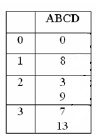
c. Compare between each element ranging from the smallest index with each element of the index thereafter. The first element of the index value must be less than the value of the index element afterwards. If there is a difference 2n then be merged. This step will generate a new group.
d. Make a back step c until there is no difference 2n.
e. Each group is given a name.
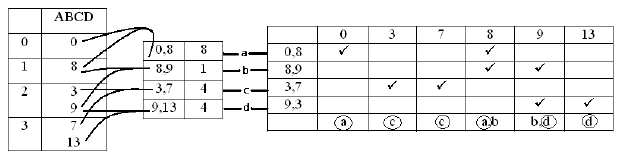
f. For completion, we take one name that represents each number (a, b, c or d). Taking the name should be as minimal as possible. So that would be obtained
F = a + c + d
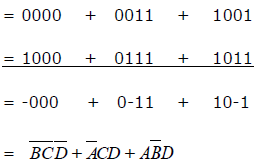
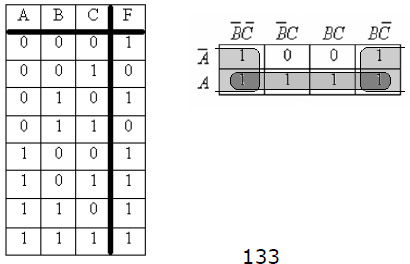
As a simplified example of the logic equations in the truth table below.

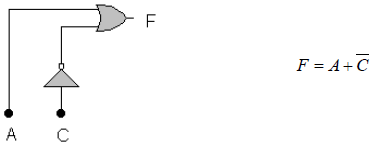
Then the logic circuit
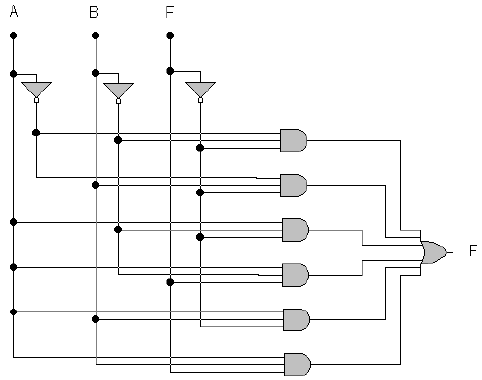
The above equation can be simplified to the methods described above.
o With Boolean algebra
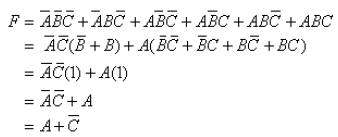
o With the K-map
o With venn diagram

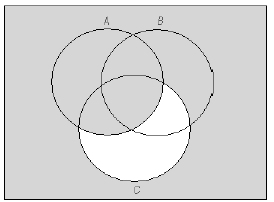
From the picture beside we can see a circle filled by shading while circle C is not filled by shading only partially filled and the rose is represented by a circle A. so

o With Quine Mc-Cluskey
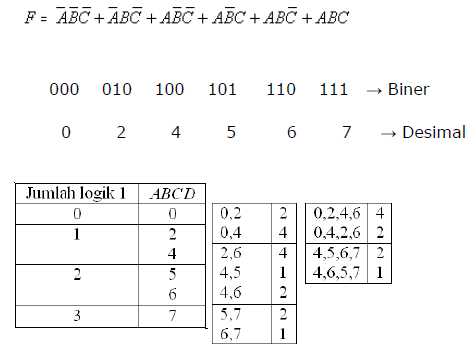
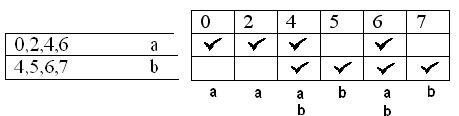
F = a + b → (0,2,4,6) + (4,5,6,7)
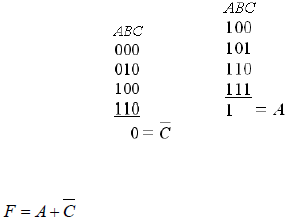
So simplification unpleasent above logic can be implemented in sequence as follows;