The stake is a piece of soft steel (mild steel), serves as a lock that is inserted between the shaft and hub (boss) a pulli wheel or the gear so that they connect with certainty so as to continue the torque / torque. Installation peg between shaft and hub is done by immersing the pegs in the groove located between the shaft and hub as a place holder pegs with elongated position parallel to the axis of the shaft.

Figure 3.6 Various kinds of Stake
The forces acting on the peg
When the shaft is used to transmit power, then the stake will work styles such as:
a. Style Radial (FR)
A style that puts pressure on the peg in the direction perpendicular to the axis of the shaft.
b. Tangential Style (FT)
The force causing shear stress and pressure fields at stake.
At work forward power swivel, the peg construction, Tangential Style (FT) is what gives the greatest value compared to. Some of the type used in connection machine elements, are:
1 Stake Bury black (PB)
This type of setting pegs mounted on the shaft half and half on the hub. Consisting of several types:
a. PB Rectangle (longitudinal sectional taper ratio of 1: 1000)
b. PB Same side / square
Here pegs width equal to the thickness.
c. Parallel PB (PB Rectangle equal to but no longitudinal cross section tapering) This form is intended to be the hub or otherwise shaft can be shifted to one another along the axis of the shaft.
d. PB Head has a shape similar to PB Rectangle but include head on one end. Serves to facilitate the process of disassembly.
e. PB Tie pegs fastened on the shaft, free on the hub or otherwise so that parts can be moved freely axially (in the direction of the shaft). Is a special type peg to move the torque / torque once allowed their axial movement along the axis of the shaft.
f. PB segment is a kind of stake that can be tuned easily, because the stake dibenam the semicircular grooves on the shaft. This type is widely used in vehicle engines and tooling. The advantages of this type of pegs are:
- Can adjust itself to the slope (taper) shape loopholes contained in the hub.
- According to the construction of the shaft with tapered at the edges, because it prevents the possibility of the release of the stake.
The drawback:
- That too in a groove on the shaft will weaken the shaft
- Unable to function as PB Tie.
2 Stake Saddlery
Consists of two types, namely:
– Stake Saddlery Flat
A tapered peg mounted fitting in the groove hub and flat on the curved shaft, so easy to slip on the shaft if subjected to an overload torque. So it can only be used for light load shafts as a sorter load.
– Stake Saddlery Curvature
A tapered peg mounted on the plot dihub fitting and the corner fitting mounted beneath the curved section of the shaft.
3 Pegs Round
Berpenampang a round peg in a hole ngepas mounted between shaft and hub. The surplus is the making of the groove can be easily after hub mounted on the shaft by means of drilled. Generally used for shafts that transmit rotary power is small. There are two installation positions or position on the shaft and hub, namely:
- mounted longitudinally (parallel to the axis of the shaft)
- mounted transversely (perpendicular to the axis of the shaft)
4 Star Stakes (Spline)
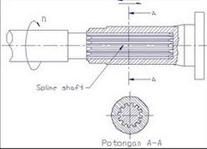
Figure 3.6 star Stake
The stake of this type has a greater strength than other types. Because of the construction materials tenons made directly on the shaft and hub are interrelated. Commonly used for shafts must transmit rotary power is great, as the machinery of power and the transmission system of the vehicle. Peg and shaft materials used are usually the same. Tenons of the numerous namely: 4, 6, 8, 10 to 16 pieces.
Because almost like its so-called peg star (Spline). Spline on the shaft usually relatively long, especially for the hub to slide-slide axially. By: D = 1,25.d and b1 = 0,25.D