Resistance Thermal Detector (RTD)
RTD is one of several types of temperature sensors are often used. RTD is made of corrosion-resistant wire, the wire is wound on the ceramic insulator material. RTD wire material for, among others; platinum, gold, silver, nickel and copper, and platinum is best material because it can be used to censor the temperature up to 1500 o C. Copper can be used for lower temperature sensor and cheaper, but copper susceptible to corrosion.
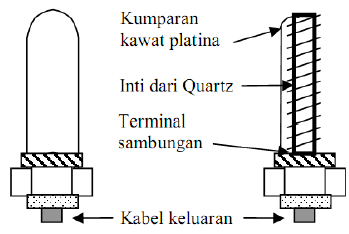
The construction of RTD in general can be seen in the following figure:

A. Cryogenic RTD
B. Hollow Annular High Pressure LH2 RTD
C. Hollow Annular LH2 RTD
D. 1/8 “Diameter LN2 RTD
In use, RTD (PT100) also has its advantages and disadvantages.
Excess of RTD (PT100):
– precision is higher than the thermocouple.
– Resistant to high temperatures.
– Stable at high temperatures, because the type of platinum metal is more stable than other types of metal.
– ability not to be disturbed in a broad temperature range.
Disadvantages of RTD (PT100):
– More expensive than the thermocouple.
– Unaffected against shock and vibration.
– Response time of starting a little long (0.5 s / d 5 seconds, depending on the condition of its use).
– Range temperatures are lower than in the thermocouple. RTD (PT100) reaches a temperature of 650 0 C, while the thermocouple reaches a temperature of 1700 0 C.
Resistance Thermal Detector (RTD) changes linearly with temperature prisoners over the test but lower than the coefficient thermistor and linear mathematical model is:
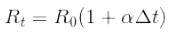
Ro = resistance of the conductor at the initial temperature (usually 0 ° C)
RT = resistance of the conductor at temperature t o C
α = temperature coefficient of prisoners
Δt = the difference between the working temperature to the initial temperature
While the quadratic nonlinear mathematical model for RTD are:

Comparison charts for variation of resistance with temperature RTD metal
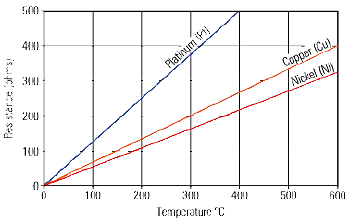
PT100 RTD is the most popular type used in industri.Resistance Temperature Detector is a passive sensor, because the sensor requires energy from outside. Elements that are commonly used on prisoners wire resistance is nickel, copper, and platinum pure mounted in a tube in order to protect against mechanical damage. Resistance Temperature Detector (PT100) is used in a temperature range of -200 0 C to 650 0 C.
Here is a picture of a PT100 sensor.
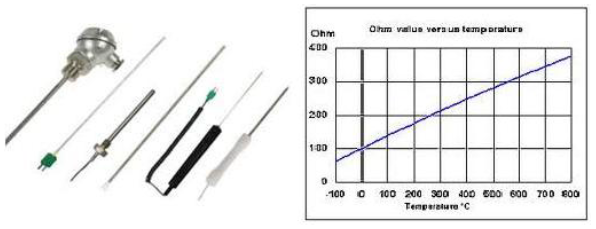
Image Sensor PT100 and characteristics
