Rotary Potentiometer Application
Example 1.
Suppose that when the wipers are above the output (figure 2.4) the resulting 10V is at an angle of 350 °, while the middle wiper produces 5 V output at an angle of 175 °. So what is the voltage generated when the wiper shows an angle of 82 °
Answer:
The resulting voltage at an angle of 82 ° = 82 ° x (10 V / 350 °) = 2.34 Vdc
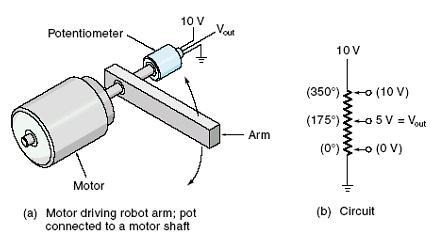
Potentiometer image as a position measurement tool
The potentiometer being discussed is actually a voltage divider and will work well if the same electrical current flows across the potentiometer resistance. The loading error occurs when the wiper of the potentiometer is connected to a circuit that has an input resistance not too large from potentiometer resistance. So the current passing through the wiper is reduced and causes the voltage reading to decrease. This can be overcome by a high impedance buffer circuit eg using a voltage follower mounted between the potentiometer with the measured circuit.
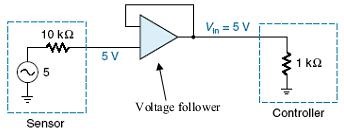
Example 2
Robot arm on the picture below. rotating 120 ° stop to stop and potentiometer used as position sensor. The controller is an 8 bit digital system and needs to know the current position with a resolution of 0.5 °
Answer:
To obtain a resolution of 0.5 ° means that all 120 ° must be divided into 240 increments and each increase is 0.5 °. The 8 bit number has 255 levels (from 0000 0000 to 1111 1111) so it’s enough for this job. The potentiometer is supplied with a 5V tension so that the output of the potentiometer is 5V for a maximum angle of 350 ° (if it is assumed the potentiometer can be fully rotated). The reference voltage of the ADC (analog to digital converter) is also 5V so that if the 5V potentiometer output voltage means the digital output is
255 (1111 1111bin). The potentiometer rotates 350 ° but the robotic arm only rotates 120 ° so the gear ratio is 2: 1. With this setting the potentiometer rotates 240 ° when the robot arm rotates 120 °
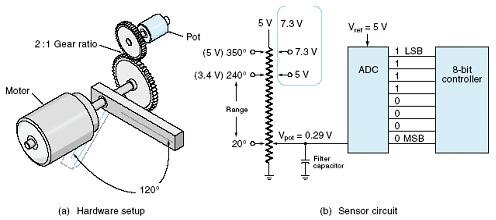
Potentiometer image as a rotation sensor on the robot arm
For example when the robot arm rotates 10 ° then potentiometer will rotate 20 °. And the potentiometer voltage is: 20 ° x (5 V / 350 °) = 0.29 V. This voltage will be converted by ADC into digital quantity: 0.29 V x (255 / 5V) = 14.8 ≈15 = 0000
1111bin
Back to the resolution problem of this measurement is:
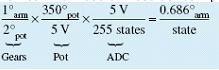
It turns out the resolution is 0.686 ° while the requested is 0.5 ° to overcome this. To improve this resolution we look back. We calculate this equation with the assumption that the potentiometer emits 5V at 350 ° but the potentiometer actually uses only 240 °. Therefore to increase the resolution can be adjusted by increasing the voltage of 7.3 V (5 V x 350 ° / 240 °). So the resolution now:
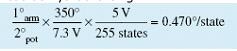
This resolution is still within the range of 0.5 ° to specification
