Charging and Discharging Capacitors
Capacitors are electronic components that can be used to store electrical charges within a certain time. Capacitors are generally made of two pieces of the conductor plate inserted down the middle slab called the dielectric insulator. If a capacitor is connected with the direct current source in a while there will be an electric current which flows into the capacitor, the condition is called a capacitor charging process, if the electric charge on the capacitor is full, the flow of electric current stops.
When the capacitor in relation to exchange polarity, the electric charge will flow back out of the capacitor. Electric voltage on the capacitor is proportional to the electric charge stored in the capacitor, it can be written as: (V = Q / C)
Capacitance (C) of a capacitor is defined as the ratio of the amount of charge (Q) with the potential difference (V) between the conductors. Or in other words the amount of load capacitance is divided by the potential difference. Which is formulated as follows:

Based on the definition of the unit of capacitance is coulomb / volt called Farad. -> 1 farad = 1 coulomb / volt
One farad is defined capacitance of a capacitor which requires that the charge 1 coulomb potential difference of one volt on the plates. One Farad is a very large unit, in practice use smaller units of micro Farad (μF) and pico farad (pF). 1 farad = 106 micro Farad (μF) = 1012 picofarads (pF) capacitor is a passive component that can store electrical energy for a moment and then let go. The nature of the capacitor is what produces a transient voltage or voltage transition when used source of direct current.
charging Capacitors
When the switch S is connected to position 1 then there is a closed circuit between the voltage V, the switch S, resistance R, and C. The current will flow from the voltage source capacitor through resistance R which is marked with a red arrow. This will cause an increase in the potential difference Capacitors Thus, the current will decrease so that at some point the source voltage will be equal to the potential difference in the capacitor.
But the flow will decrease when the source voltage is equal to the potential difference in the capacitor and the current will stop flowing (I = 0). When the switch S is connected to the 2nd position at the time the capacitor is still full of cargo. Because of the current will flow through the detainee R. At the moment there is a process to discharge the capacitor, the capacitor voltage will decrease so that the current through the resistance R will decrease. At the time of the capacitor has gotten rid of the entire payload (Vc = 0) so as to stop any current flow (I = 0).

Figure 5.14. The series R-C With Voltage Source Unidirectional
If at time t = 0 the switch is moved to position 1 then there will be current flows to charge the capacitor, the capacitor until full. The current flowing while the smaller the capacitor voltage bigger. This process is called the process of charging the capacitor. To determine the amount of current and voltage can be made the equivalent circuit like Figure 5.15. as follows :

Figure 5.15. To Determine the equivalent circuit V and I are charging
In accordance with the laws of Kirchoff II on the voltage, the amount of voltage
in a closed circuit is equal to zero. Or
– V + VR + VC = 0
VR = i R where i = dq / dt
VC = q / C
– V + i R + q / C = 0
If V remains then flows into i = V / R – q / RC. At time t = 0, q = 0, the current at t = 0 is called the initial current I0 = V / R. Because the greater the charge q q / RC bigger and the smaller the current, when the current i = 0, then

Charging and Discharging Capacitors with input box
A test circuit for charging discharging as shown below, with a square wave generator simulates voltage direct current in the “on-off” right. At t = 0 – 50ms high-voltage generator circuit mesimulasikan received direct current voltage, when t = 50 -100ms circuit gets voltage of 0V.

Figure 5.17. Test circuit Charging and Discharging Capacitors
From the experimental results depicted on screen CRO illustrated in the figure below.

Figure 5.18. Capacitor charging and discharging curves
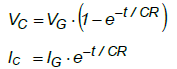
Visible time t = 0 the high-voltage generator (on), but the voltage VC is not immediately as high-voltage generator, but exponentially rises, which at its peak maximum after 5 τ. While the current, which is measured by the CRO on resistance R) at t = 0 it shows the maximum level, then exponentially down, until after 5 τ value is zero.
Multiplication of prisoners with a capacitor referred to as the time constant
symbol
τ = R. C
R = Resistor / custody
C = Capacitor
= Constant time
The voltage and current in charging