Definition and Nature Circuit Series Resistors
For practical purposes, all the conductor materials that are used in particular as a drag stream is referred to as “Resistors” or some are calling it a “prisoner”. In terms of materials and construction, the resistor can be differentiated as follows:
– Shaped wire coil or a mixture of materials Nikelin nichrom on ceramic / plastic for large power
– Shaped mixture of carbon materials for small power up to ½ watt
– Shaped metal deposition on ceramic
– Shaped carbon deposits on ceramic
Practical use of a resistor in a circuit is as follows:
– As the elements of calibration meter needle, such as a shunt resistor for ampere meter and volt meter series resistor for
– As current regulator in an electrical circuit for example reostat
– As an example voltage divider potentiometer
– As heating elements, such as resistors made of Nikelin or Nichrom.
If three resistors are connected as shown below then referred to as a relationship or a resistor series circuit.
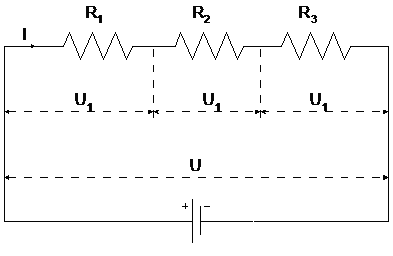
Figure 3.26 resistor series circuit
The circuit characteristics Series
– The current flowing in the series circuit is always the same along the current path in a circuit, because there is only one current path in series. The current in a series circuit is expressed in the following equation:
It = I1 = I2 = I3 = I4 = ……
– Total resistance is R, in series is the sum of all resistance in the circuit. Resistance in series is expressed in the following equation:
Rt = R1 + R2 + R3 + R4 + ……
– Voltage in series are used fully by all the resistance in the circuit. The load on the series circuit must share the voltage supplied to the circuit. Thus, the voltage supplied to the circuit will be divided at each electrical load is there.
– The voltage received by each load will change depending on the value of the load resistance. Changes in voltage at each load is called the voltage drops. Voltage drop is the amount of voltage (electrical pressure) is used or lost through on any load or conductor in the process of moving electrons (electrical current) through the current path in the circuit. Voltage drop on each load is proportional to the value resistannya.
– The number of jath voltage in a series circuit is equal to the value of the voltage applied to the circuit. It is expressed in the following equation:
Et = E1 + E2 + E3 + E4 + …… ..
– Ohm’s Law can be used to compute each section in series or series total. Figure 3.5 shows the series with four resistance heaters with different values. Calculation of total resistance, current, and voltage drop on each load of heating can be done in the following way:
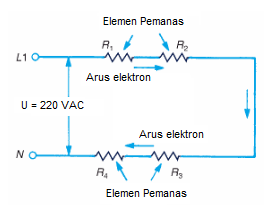
3:27 Picture 4 resistance in series with the circuit
Figure 3.27 shows a series circuit consisting of four resistance of the heating element. The resistance of each element is R1 = 4, R2 = 10, R3 = 12, and R4 = 14. The series circuit is connected to the source voltage of 220 V.
How to calculate total resistance:
Step 1: Use the formula
Rt = R1 + R2 + R3 + R4
Step 2: Substitute the resistance value of each resistor
Rt = 4 + 10 + 12 + 14
Step 3: Complete the equation
Rt = 40 Ω.
How to calculate the total electric current:
To calculate the electric current flowing in the series circuit is used Ohm’s Law.
Step 1: Use the formula

Step 2: Substitute the value of the voltage (U) and the value of the total resistance (Rt).

Step 3: Complete the equation
I = 5.5 ampere
Ohm’s Law to calculate the voltage drop in the first heating element (R1).
Step 1: Use the formula
U = I x R1
Step 2: Substitute the value of the total current (I) and resistance value
The first heater element (R1).
U = 5.5 x 4
Step 3: Complete the equation
U = 22 volts
Calculating the voltage drop on R2:
Step 1: Use the formula
U = I x R2
Step 2: Substitute the value of the total current (I) and the first heater element resistance value (R1).
U = 5.5 x 10
Step 3: Complete the equation
U = 55 volts
Calculating the voltage drop on R3:
Step 1: Use the formula
U = I x R3
Step 2: Substitute the value of the total current (I) and the first heater element resistance value (R1).
U = 5.5 x 12
Step 3: Complete the equation
U = 66 volts
Calculating the voltage drop on R4:
Step 1: Use the formula
U = I x R4
Step 2: Substitute the value of the total current (I) and the first heater element resistance value (R1).
U = 5.5 x 14
Step 3: Complete the equation
U = 77 volts
Calculating the total voltage:
Step 1: Use the formula
Et = E1 + E2 + E3 + E4
Step 2: Substitute the value of the total current (I) and the first heater element resistance value (R1).
E1 = 22 + 55 + 66 + 77
Step 3: Complete the equation
U = 220 volts
