Kirchoff’s Law Power
To complete the calculation of electrical circuits or meshes, a natural scientist from Germany named Gustav Kirchoff has found two ways then this way becomes law known as “Kirchoff’s Law”.
Kirchoff’s Law I of Flow
Kirchoff’s Law I for series or grid reads: “The algebraic sum of electric current at a branching point is always equal to zero” In figure 4.1 Kirchoff I explained the law as follows:
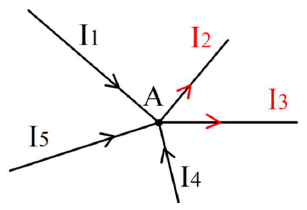
Figure 4.3 The point of branching flow
From the above picture I2 and I3 current direction opposite to the direction of the current I1, I4 and I5. So at the branching point A valid:
I1 + I4 + I5 – I2 – I3 = 0 or I1 + I4 + I5 = I2 + I3
So the equation of Kirchoff’s Law can be written with the general form
Σ I = 0
Examples of application of Kirchoff’s Law 1 is like the circuit below as an application as a flow divider.

Figure 4.4. Image Flow divider circuit
The equations obtained from the circuit above are as follows:
Flow i = i1 + i2 and Voltage V = i1. R1 = i2. R2
Kirchoff’s Law II of voltage
Law Kirchoff II relates to electrical circuit is closed which states: “In a closed circuit, the algebraic sum of the voltage (V) with losses of voltage is always equal to zero” This law is generally written by the formula: ΣV = Σ R x I in Figure 4.5 with no regard to the offset voltage in the battery (the battery prisoners considered small) then: V – (IR) = 0 or E = I. R’s according to Ohm’s Law.

Figure 4.5 The electrical circuit is closed
In direct current electrical network to meperoleh a certain voltage can use a combination of certain prisoners, the circuit is called a voltage divider circuit. Simple voltage divider circuit which can be shown by Figure 4.6 below
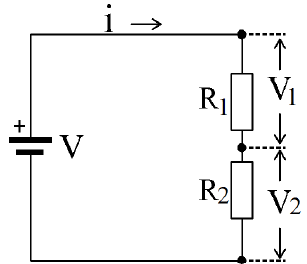
Figure 4.6. The voltage divider circuit
The amount of current flowing in the circuit is

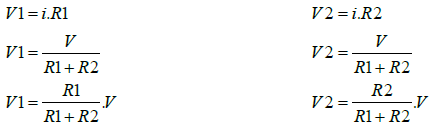
Voltage on R1 is the voltage on R2 is