Parallel Circuit Characteristics
Calculations must be performed by a technician / mechanic associated with parallel rangkaiann highly unlikely. But no matter how well the properties of parallel circuits should be understood by the technicians / mechanics field. The current drawn by each branch is determined by the parallel circuit of resistance that exist in the branch circuit. The total current drawn by the circuit is the sum of all current parallel branches.
Current on each branch of parallel can be calculated using Ohm’s law, if resistannya known. The voltage across each parallel branch is always the same, the voltage across the parallel circuit is expressed in the following equation:
Ut = U1 = U2 = U3 = U4 = ……
Total resistance value or the equivalent resistance (RT) of the parallel circuit will lower the value of the smallest resistance in a parallel circuit. In mathematics can be written as follows:
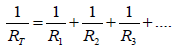
Because the voltage drop on each load in parallel branches of the same, then the current received by each load in each parallel branch will change depending on the value of the load resistance. Flow at branch faithfully inversely proportional to the value resistannya. In mathematics can be written as follows:

The amount of current in a parallel circuit is equal to the current value on each parallel branch. It is expressed in the following equation:
It = I1 + I2 + I3 + I4 + …… ..
Ohm’s law can be used to calculate the parameters of each element in series or series total. 3:41 Picture shows a parallel circuit consisting of two heating elements that have resistance with different values. Calculation of total resistance, current, and voltage drop on each load of heating can be done by applying Ohm’s Law as follows:
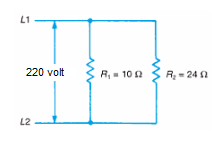
Parallel circuit 3:38 image 2 Resistor
How to calculate total resistance:
Step 1: Use the formula

Step 2: Substitute the resistance value of each resistor

Step 3: Keep the same denominator and totalizing
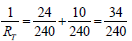
Step 4: Complete the equation by reversing the equation
Rt = 240/34 = 7:06 ohm
How to calculate the total electric current:
To calculate the electric current flowing in a parallel circuit use Ohm’s Law.
Step 1: Use the formula

Step 2: Substitute the value of the voltage (U) and the value of the total resistance (Rt).

Step 3: Complete the equation
It = 31.16 ampere
Ohm’s Law to calculate the current of each branch (R1).
Step 1: Use the formula

Step 2: Substitute the value of the total current (I) and the first heater element resistance value (R1).

Step 3: Complete the equation
I1 = 22 amperes
Calculate the current second branch at R2:
Step 1: Use the formula

Step 2: Substitute the value of the voltage (U) and the first heater element resistance value (R2).

Step 3: Complete the equation
I2 = 9.16 amperes
Calculating the total current total:
Step 1: Use the formula
It = I1 + I2
Step 2: Substitute the current value I1 and I2 current values
It = 22 + 9.16
Step 3: Complete the equation
It = 31.16 ampere
