Understanding Capacitors
The capacity of a capacitor is expressed in units Farrad (F) However the 1 Farrad is a very big price for a capacitor. In the capacitor market is generally sold in sizes much smaller capacity than 1 Farrad. For polar capacitor (bi-polar) with a dielectric material with an electrolyte solution sold Farrad micro units, generally from 0.1 micro Farrad to 47000 mikroFarrad (47 miliFarrad). As for the non-polar capacitor is generally provided with a smaller capacity again, ranging from 1 000 to 1 pikoFarrad nanoFarrad.
1 picofarads (pF) 1 x10 -12 F
1 nanofarad (pF) 1 x10 -19 F
1 microfarad (pF) 1 x10 -6 F
A capacitor can be formed by two conductive plates mounted in parallel and separated by a dielectric material that also serves as an insulator. Mathematically relationship capacitance value of a capacitor is determined by the following equation:
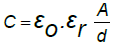
Where C is the amount of capacitance in farads (F);
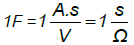
-> A: current in units of Ampere, V: voltage in units of Volt, s:
the time in second (sec)
Ԑo is an absolute permetivitas
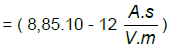
Ԑr is permetivitas relative dielectric konstata
A in Equation 1.87 is the cross sectional area of the plate
d is the distance between the two plates, the thick dielectric
From the above equation that the value of the capacitance of a capacitor is determined by the cross sectional area of the plate, relative permittivity and dielectric materials. In order to get the physical form of a small capacitor, it is usual to obtain adequate capacitance value, made a comparison with the quantities determined such that the selected area of the plates are large with high permittivity and dielectric thin.
Comparison of the value of the capacitance of a capacitor to volume is important because in general the space available for a very limited capacitor. In most types of capacitors made from thin sheets of paper long-conductive plastic and are separated by a thin dielectric, then rolled together. The problem here is most likely only be obtained very limited capacitance value is approximately only be obtained until a few microfarad only.
Another obstacle is that the dielectric which has insulating properties and is relatively very thin, in fact be able to withstand reverse voltage DC sufficient without being damaged, so the selection of dielectrics will determine the strength of a capacitor.
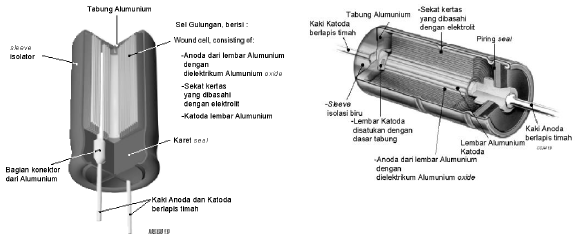
Figure 5.1. Construction A Capacitors
The amount of the total charge that can be stored Q is determined by the value of the capacitance C multiplied by the magnitude of the DC voltage imposed on both ends of the plate, and this is usually often used as a measure of the efficiency of a capacitor type.
Q = C x V
