Thermal Sensor
AIR CONDITIONING. Srivastava (1987), said temperature is one of the four basic quantity that is recognized by the International Measurement System (The International Measuring System). Lord Kelvin in 1848 proposed a thermodynamic temperature scale at a fixed point of the triple point, where the solid phase, the liquid and vapor are together in equilibrium, this figure is 273.16 ° K (degrees Kelvin) which is also a point of ice. Another scale is the Celsius, Fahrenheit and Rankine with the following relationship:
o F = 9/5 ° C + 32 or
o C = 5/9 (° F-32) or
o R = ° F + 459.69
Yayan IB, (1998), said temperature is an important condition of a substrate. While the “heat is a form of energy that is associated with the activity of the molecules of a substrate”. Particles of a substrate is assumed to be always on the move. The movement of the particles is then perceived as heat. While the temperature is a measure of the ratio of the heat.
The movement of the substrate particles can occur in the three-dimensional objects, namely:
1. Solid objects,
2. Liquids and
3. Benda gas (air)
Dimensional heat flow substrate in solid, liquid and gas can occur:
1. Conduction, the heat flux through solid objects (conductor) by direct contact
2. Convection, the convection through the liquid medium by direct contact
3. Radiation, the heat flow through the medium of air / gas in indirect contact
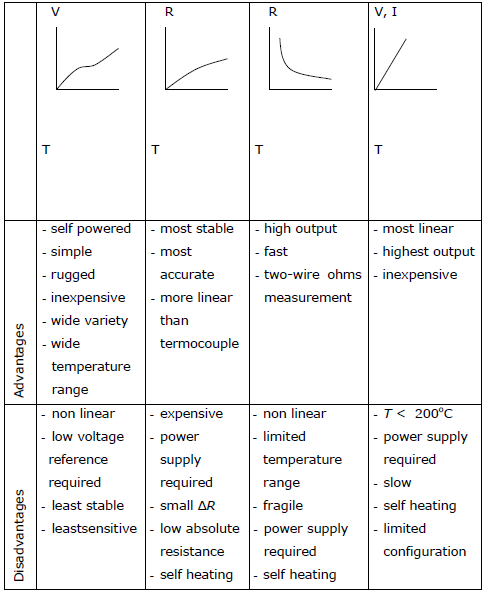
On the application of specific detection or measurement, can have one type sensor with the following considerations:
1. Appearance (Performance)
2. Reliability (Reliable) and
3. economic factors (Economic)
1) Selection of Temperature Sensor Type
Things that need to be considered in connection with the selection of temperature sensors are: (Yayan IB, 1998)
1. Level the maximum and minimum temperature of a substrate is measured.
2. Coverage (range) Maximum measurement
3. The heat conductivity of the substrate
4. Response time to changes in temperature of the substrate
5. The linearity of the sensor
6. The working temperature range
Apart from the above provisions, it should also be noted the physical and chemical aspects of sensors such as resistance to corrosion (rust), resistance to shocks, wiring (installation), security and others.
2) Work Tempertur Sensor
Each temperature sensor has a different operating temperatures, for measuring the temperature around the room which is between -35 ° C to 150 ° C, selectable sensor NTC, PTC, transistors, diodes and hybrid ICs. For medium temperatures of between 150 ° C to 700 ° C, selectable thermocouple and RTD. For higher temperatures up to 1500 ° C, it is not possible anymore sensors used in direct contact, the technical measurement performed using radiation method.
For the measurement of very cold temperatures in the region below 65 ° K = -208 ° C (0 ° C = 273.16 ° K) may be used ordinary carbon resistors because at this temperature the carbon acts like a semiconductor. For temperatures between 65 ° C to -35 ° C can be used with high-purity silicon crystal as a sensor.