Strain Gauge Sensor
Strain Gauge is an electronic component used to measure pressure (deformation or strain). This tool is in the form of metal foil or metal wire that is insulative (insulation) attached to the object to be measured pressure, and the pressure comes from loading. The principle is that if the pressure on the object changes, the foil or wire will be deformed, and the electrical resistance of the tool will change. This change of electrical resistance will be incorporated into a series of Whetstone bridges which will then be known how much resistance the Strain Gauge is.
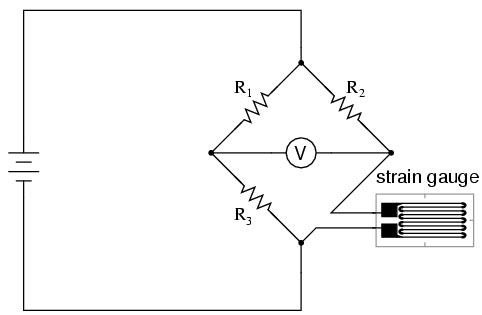
The output voltage of the Wheatstone bridge is a measure of strain that occurs due to the pressure of each Strain Gauge sensing element.
Symbol of the Gauge Strain

The pressure is then connected with strain according to Hook’s law which reads: The elastic modulus is the ratio of pressure and strain. Thus if the elastic modulus is an object surface and strain is known, then the pressure can be determined. When two Gauges or more are used, then the pressure on tracking the direction of each Gauge can be determined using the calculation. However, the equation has different levels of complexity depending on the combination and orientation of the Gauge.
The sensitivity of a Strain Gauge is called by the Gaugedan factor comparison between the unit resistance with the unit length change is:

Where :
ΔR = Changes in Gauge resistance
Δl = Changes in material length
R = Nominal Gauge Resistivity
l = normal length of material
So strain is defined as a dimensionless comparison, multiplication of the same unit, for example microinci / inch or generally in percent (for large deformations) or most commonly in microstrains. The characteristics of the filaments are as follows:
1) Highest Gauge Factor
2) Low temperature coefficient of resistance
3) High resitivity
4) High mechanical strength
5) The minimum thermo electric potential around the lead
