Basic Circuit of Photo Transistor Sensors
This component has the same properties as the transistor that produces the cut off and saturation conditions. The difference is, when the transistor cutoff condition occurs when no current flows through the base to the emitter and saturation conditions occur when there is current flowing through the base to the emitter then the phototransistor cutoff condition occurs when no infrared light is received and saturation conditions occur when there is infrared light received.
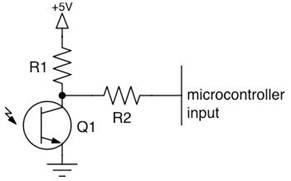
The cut off condition is the condition in which the transistor is in the OFF state so that the current from the collector does not flow to the emitter. In the series above picture, the current will flow and bias base transistor Q2 C9014. The saturation condition is a condition in which the transistor is in ON state so that the current from the collector flows into the emitter and causes the transistor Q2 to not get biased or OFF. The ST8-LR2 phototransistor has a 15-degree corner area and a blue protective layer that protects the sensor from wild lights. In phototransistors that are not equipped with this protective layer, wild lights can lead to false indications sent to the CPU and disrupt the processes that are there.
The application of this component as a touch sensor is used in conjunction with Infrared LEDs emitted to the ground. When the ground or floor surface is light, the infrared signal will be returned to the sensor and received by ST8-LR2. But if the surface of the ground or floor is dark, then the infrared signal will be absorbed and little or no return. How to arrange Photo transistor can be seen in the picture below
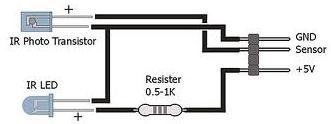
Photo transistor is a light sensor that can be used for applications with infrared light and sunlight. Photo transistors can be operated directly to obtain the output logic from the light changes received by the photo transistor or by adding transistor boosters to improve the performance and speed of the photo transistor response.
