Measuring Capacitors and Diodes
a. Measuring Capacitors
Capacitors are electronic components that are designed to be able to store and dispose of Unidirectional Voltage Power Lines (Direct Current Voltage / DCV). Capacitors are divided into two types. First, the capacitor has the anode (+) and negative (-). In the electronics technique called a polar capacitor (polarized capacitor). Second, the capacitor has no anode (+) and negative (-). Known non-polar capacitor (unpolarised capacitor).
It is important to note in measure polar capacitor is;
A. Cable investigator (probes) positive (+) red is placed at the foot of capacitors marked with a positive (+).
B. Cable investigator (probes) negative (-) black put on foot capacitors marked with a negative (-).
C. The switch in the position Ω measuring range, measuring limit (range) in the position of x1, x10 or kΩ, as needed.
D. For non-polar capacitor (unpolarised) both wired investigator (probes) can be placed arbitrarily (random) to the foot of the capacitor. See figure 15.
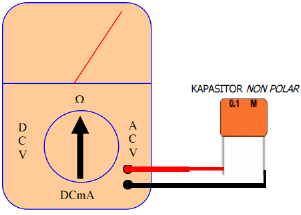
Figure 15. Measuring Capacitors
b. Measuring Diodes
Diodes are electronic components that has two electrodes, namely; (1) Anode (a), and (2) Cathode (k). Follow the arrows on the diode symbol (Figure 21), an electric current to flow in only one direction, namely from Anode to Cathode. Electric current will not flow from the cathode to the anode. Things to remember when measuring a diode with Multimeter is:
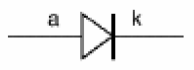
Figure 21. Diode Symbol
A. Cable investigator (probes) red (+) placed at the foot of anodes, cable investigator (probes) black (-) Cathode placed on the legs.
B. The switch in the position measuring range Ohms (Ω) and the limit of measurement (range) at the position x1, x10, or x1kΩ, as needed. See figure 22.
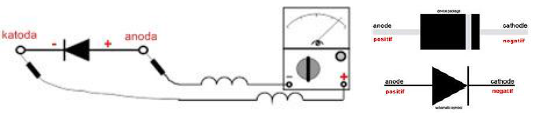
Figure 22. Diode Measurement
