Relays and Contactors
In effect the construction of relays and contactors same, which consists of a solenoid coil and a few pairs of electrical contacts. But seen from a different use. Relay is often used for the control and regulation functions, being contactors commonly used for the power switching function. Rele used extensively in the control system indirectly to operate the motors, valves, magnetic clutch, and the heating element (heater).
Figure 2.5 shows various examples of industry standard relay.
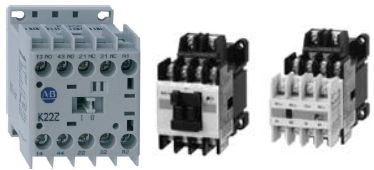
Figure 2.5 Construction of various Rele
A typical relay standards issued by various manufacturers, can usually be distinguished from the number of poles (contacts), the contact status, the ability of current and working voltage coil solenoidnya. Judging from the number of poles (contacts), distinguished relay with four poles, five poles and eight poles. Configuring the ignition as follows, for a 4 pole relay contacts can alternate apartment layout is 4 NO, 3NO + 1NC, 2NO + 2NC. For relays with 5 poles apartment layout the ignition is 5 NO, 4NO + 1NC, 3NO + 2NC, 2NO + 3NC, 1NO + 4NC, and 5 NC. To relay with 8 poles, the ignition apartment layout is 8N), 7NO + 1NC, 6NO + 2NC, 5NO + 3NC, and 4NO + 4NC.
Standard operating voltage for the solenoid coil relay is generally used source of alternating current 50Hz-60Hz, with a voltage value as follows, 100V – 110V, 200V – 220V, 380V – 400V, and 400V – 440V.
The range of operating current relay or commonly known as the nominal current of relay contacts which can be held by the relay varies depending on the working voltage received by kontaknya.Pada contact voltage 110VAC then the nominal current is 6A, at the 220VAC voltage, nominal current 3A, at the 440VAC voltage, current nominal 1.5A and voltage 550VAC nominal current 1,2A.
The range of nominal currents capable detained by the relay contacts on the use of resources with direct current (DC) is, at the working voltage 24VDC, nominal current is 3A, the voltage is 48VDC, 1.5A nominal current, at a voltage of 110VDC, nominal current 0,55A and the voltage of 220VDC, rated current 0,27A relay. Contact endurance perform termination operations at nominal current load operation range 500,000, or about 1800 times every hour operation.
To help identify the relay contact, usually made coding using numerical system. At each contact pair is encoded using a two-digit number, with the following rules:
Case (a): a relay having contact 4NO. Encoding the number of contacts made as follows for the first contact pair 13-14, for the second contact pair 23 -24, for the third konak pair 33-34, for a fourth contact pairs 43-44, as shown in Figure 2.6 a.
Case (b): a relay having contact 3NO + 1NC, couples first contact (NO), then the code 13-14, for couples the second contact (NC) 21-22, to partner third contact (NO) 33-34, and for couples felts contact (NO) 43-44, as shown in Figure 2.6.b
Case (c): a relay having contact 2NO + 2NC, couples first contact (NO), then the code 13-14, for couples the second contact (NC) 21-22, to partner third contact (NC) 31-32, and for couples felts contact (NO) 43-44, as shown in Figure 2.6.c
Case (d): a relay has eight pairs of contacts consists of six pairs of contacts (NO) and two pairs of contacts (NC), the encoding is shown in Figure 2.6.d.
Case (e): a relay has eight pairs of contacts consists of five pairs of contacts (NO) and three pairs of contacts (NC), the encoding is shown in Figure 2.6.e.

Figure 2.6 Symbol Relay control
Besides the standard relay as discussed above, in practice also known as rele made in the form of smaller, commonly known as a mini control relay (miniature control relays). As shown in Figure 5.7. Mini relay is designed as necessary users for various purposes, mini-sized and compact, sturdy and has a power capacity tinggi.Konstruksi mechanical relay coated with polikarbon and dust free.
