Thermostat and Pressure Switch
a. Thermostat
Thermostat is a device temperature control cabinet or room temperature that works automatically. This tool will decide the motor compressor (cut off) from the grid voltage, if the room temperature has been mencapa preset value and will connect the compressor motor to the grid voltage (restart), if the room temperature is above the desired niai. Temperature cut-off can be adjusted by turning a knob until it reaches the desired limit price.
In general Thermostat is designed with kompak.Semua construction of metal parts made of corrosion resistant metal (stainless steel or zinc plated). Usually the temperature sensing element in the form of bulb that contains a certain refrigerant gas is connected to a membrane (bellows) through a capillary tube. Type the switch there are two kinds, namely SPST or SPDT, in which the switch contacts will close when bulb temperature rises. The strength of current-carrying contacts 6A thermostat is at a voltage of 240 VAC to 20 A at a voltage of 240 VAC.
The assembly uses two M4 screws, 55 mm, or M10. Figure 2.19 is a typical standard thermostat that has an arrangement that is setting range.Thermostat this type are commonly used in the refrigerator / freezer for domestic purposes.
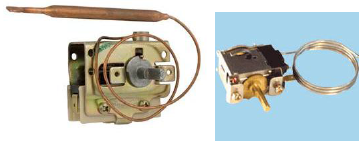
Figure 2.19 standard mechanical Thermostat

Figure 2.20 Thermostat mechanical equipped with two kinds of settings (range and differential)
Figure 2.20 is a mechanical thermostat is equipped with two types of scale is a scale for setting range and scale for setting Differential.Thermostat this type are commonly used in commercial refrigeration systems, for example, display case, and cold storage. The thermostat has a contact operating mechanism is sturdy and sealed with so free of dust. Temperature cut-out and cut-in can be set independently for the setting differential.
b. Pressure switch
Figure 2.21 shows the typical pressure switch which is commonly used in commercial and industrial refrigeration equipment. Commercially available two types of pressure switches, namely Single pressure control (low pressure switch, or high pressure switch), and double prossure control, (having low and high pressure switch (right)). There are 3 types of arrangements contact, namely SPST, SPDT and DPST. Table 2.3 shows the various symbols of the automatic switch.
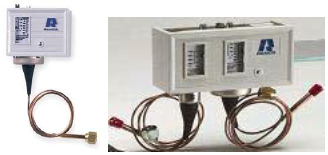
Figure 2.21 Pressure Switch
2:22 image shows a typical use of the thermostat and the low pressure control on commercial refrigeration units. In Figure (a), visible solenoid valve (s) mounted on refrigerant channel that will go into the evaporator before the expansion valve (refrigerant flow control). Solenoid valve (s) connected to the grid voltage (power line) via the thermostat (T). The working process of this system are as follows: In normal operating conditions, the thermostat contact is closed, so that the solenoid (S) works, refrigerant flowing into the evaporator through the expansion valve to regulate the debits.
If the evaporator temperature is lower, the remote bulb temperature is also getting down. If the remote bulb temperature drops to a certain point, the appropriate setting of the thermostat, the thermostat contacts open, the solenoid is inactive, ferigeran flow to the evaporator stops, and the cooling process also stops. In Figure (b), seen the compressor motor is connected to the grid through a low voltage single phase pressure control. It is intended, when the control device (low pressure control) to detect very low pressure in the compressor suction line, due to the refrigerant temperature is too low, the low contact pressure control will be open, so that the compressor motor stops.
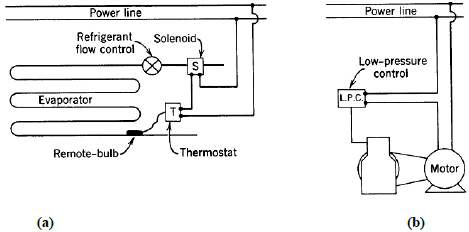
Pictures 2:22 Typical use of thermostat and Low Pressure control in a commercial unit
