Composition Fruits
Components of fruit which is very important in contributing nutrients in our diet, especially vitamin. Vitamins are contained in various types of fruit are also different, both the type and amount. In addition to vitamins, fruits also contain nutritional components such as protein, fat, carbohydrates, and water. In general, protein and fat content in fruits is relatively low, except for certain fruits, for example avocado which has a fairly high fat content, while the water content is high enough so that this water component that primarily effects when consumed fresh.
The nutritional composition of various types for every kind of fruit: Different influenced by several factors, including differences in varieties, climatic conditions where growing, crop maintenance, harvesting, degree of maturity at harvest, conditions during curing and storage conditions. The composition of various types of fruits can be seen in Table 2.1.
Table 3. Composition of various kinds of fruits
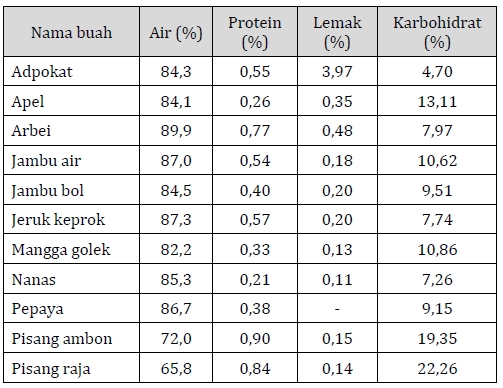
Source: Directorate of Nutrition, Ministry of Health (1967)
Klimaterik and Non klimaterik
Klimaterik can be interpreted as the state fruit stimulation towards maturity occurs “auto” (auto stimulation). The process is also accompanied by an increase in the respiratory process. Klimaterik also a sudden unique period for certain fruits. During this process a series of biological changes that begins with the formation of ethylene, which is an unsaturated hydrocarbon compounds are gaseous at room temperature.
Fruits belonging to the fruits klimaterik are: banana, mango, papaya, avocado, tomato, sapodilla, apples and so on. Instead fruits that do not have a pattern like fruit klimaterik nonklimaterik classified as a fruit. Examples of fruits that belong to the group nonklimaterik fruit is watermelon, oranges, pineapple, grapes, cucumber and so on. Profile pieces belonging to the fruit klimaterik and non klimaterik can be seen in the following figure.

Figure 15. Profile fruit klimaterik

Figure 16. Profile of fruit non klimaterik
