Principles and Objectives Cleaning Materials
Cleaning is a process that can be said to be simple but able to deliver impact and benefits are enormous. Perbersihan aims to remove dirt or unwanted material that is attached to or carried on agricultural and fishery products after the material is harvested. Hygiene agricultural commodities and fishery greatly affect the quality, especially the appearance of the material.
Besides dirt or other foreign matter can become a source of contamination which would result in material damage, particularly if the contamination in the form of microorganisms. Therefore, prior to shipping, agricultural products must be cleaned of dirt and the parts that are not needed. Cleaning commodity fishery products, especially fish, aims to remove dirt which is largely a source of microbes found in the fish’s body.
Cleaning is very dependent on the size of the fish. In the large fish (such as snapper, mackerel), scales, gills and entrails should be cleaned first. After that, there was cleavage along the line of the back to the stomach (but should not be split in two) so that the meat is not too thick. Entrails removed by pulling the gills slowly until the entire contents of the stomach can be pulled through the gill cavity.
In the medium-sized fish (laying, bloating, or tilapia) do not need to be split, simply discarded scales, gills and entrails. While very small fish (anchovies, petek) the fish are cleaned with water alone without the need to clean the scales, gills and entrails.
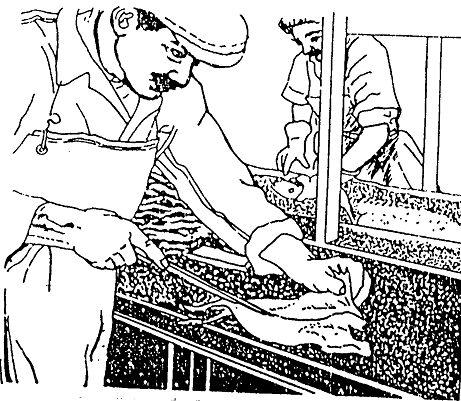
Figure 23. How to split the fish
Impurities in materials agricultural and fishery products, can be grouped based on its form may be some groups, such as:
a) Impurities such as land
This debris is usually a byproduct of dirt attached to the agricultural produce when harvested material, especially commodity tubers such as cassava, taro, potatoes carrots and others. Usually in the form of ground dirt, dust, and sand. This dirt is a good medium as the growth and development of microorganisms that could potentially damage agricultural produce. Impurities such as dust and soil can also contaminate vegetables and fruits, especially the adjacent crop land.
b) Impurities in the form of residual harvesting
This kind of dirt which include residual impurities harvesting plants that are part of the plant, such as: leaves, branches, twigs, seeds, skin and others.
c) Impurities in the form of foreign objects
Foreign body dirt is dirt that is not part of the plant. Impurities such as foreign objects bleak nails, stones, cigarette butts etc. The dirt there because of carelessness in handling the crop.
d) biological Stools
Dirt is in the form of living beings and metabolites such as insects and dirt mixed with other biological materials agricultural and fishery products. This debris can carry germs such as cholera, typhoid, dysentery and others.
e) Dirt microbiological
Microbiological dirt and metabolites such as microorganisms such as fungi, bacteria and other ingredients are mixed with agricultural and fishery products. These impurities can also carry germs such as cholera, typhoid, dysentery and others.
f) Impurities in the form of residual chemicals
This kind of dirt is a chemical derived inter alia from pharmaceuticals pesticides, fertilizers, and indstri fumes that pollute the air and waste-waste from factories that pollute rivers and seas. This debris can cause poisoning in consumers. At certain concentrations, the chemical can cause poisoning directly. Whereas at low concentrations, and if constantly consumed will accumulate in the body and can cause health problems. Separating the impurities present in materials of agricultural and fishery sorting process can be done manually, using simple tools and use complex tools and washing process.
