Characteristic Curves Pump
Pump characteristic curve also called the performance curve, describes the relationship between capacity, head, power and efficiency of pump (Figure 9:17). Knowledge pump characteristic curve is required to select a pump on certain operational conditions that give high efficiency and low operating costs. Generally Head, input power and efficiency is structured as ordinate while the capacity as abscissa at a constant pump speed.
NPSH when shown are also mounted on the ordinate. Approximately 6-12 point used during the test pump (pump test). Smooth curves connected at these points. Head curve – shows how much capacity the water flow will be issued at a certain head. Debit increases with decreasing head. Efficiencies generated increased from zero at zero discharge up to a maximum point and then decrease again.
BHP in centrifugal pumps usually come up on a hose as discharge increases, reaching a maximum point. This curve changes with the speed of the pump. Then the speed should be considered in selecting a pump to get the maxi-mum efficiency. Each curve has also changed the type of pump.

Figure 58. Typical Characteristics Curves Centrifugal Pumps
How to read the curve, for example in Figure 9:17 desired to get a head, HP and efficiency at capacity. By reading the curve of intersection between the head, BHP will be obtained efficiency.
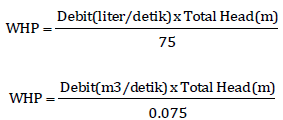
Water Horse Power (WHP):
Water horse power (WHP) is the theoretical horsepower required to pump water with a certain flow and high head. Head and discharge expressed in horsepower (horse power).
or
1 HP = 75 liters / detik.meter = 0,075 m3 / sec meter = 0.74 KW.
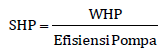
Shaft Horse Power is the power needed at the pump shaft.
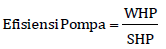
Efficiency is the ratio between the power output to power input.
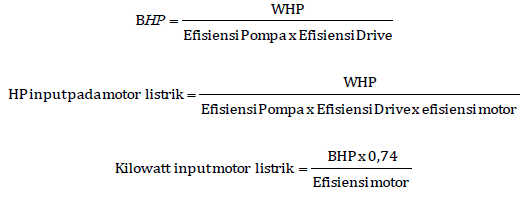
Brake Horse Power is the actual power required by the machine for pumping:
When used, the direct connection BHP = SHP
When using a belt (belt) or other connective then: