Exploration Drilling
The purpose of this exploratory drilling is to prove the existence of a basin containing oil or gas. At the beginning of this drilling, the data is not yet available accurate drilling that requires proper planning taking into account the possibilities of problems that occur during the drilling operation. Also required scrutiny during the drilling process because the depth of the layers of rock that have the properties of different rocks penetrated by the drill bit is unknown, data rock properties observed noteworthy appropriate depth.
In fact, the depth of the final (target) target in drilling is still changing this bias was observed in the data as well as data logging drill powder. Therefore, the construction of wells covering casing design, cementing, mud, bits and other material causes the drilling costs are more expensive. Exploration wells wells often referred to as “Wild Cat”, meaning that during the drilling operation will be found many problems that drilling will be found that lead to longer and more expensive because the purpose of exploration drilling is to get the most accurate data possible.
In general, exploratory drilling carried out the first time, a point located at the top of a reservoir shaped anticline trap. Picture of the first exploration drilling can be seen in Figure 3.2.
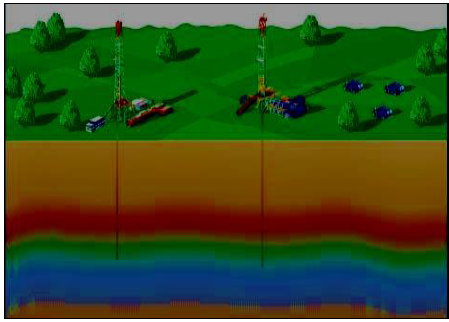
Figure 3.2. Exploration drilling
In Figure 3.2. seen that there are three layers of reservoir fluid that is composed from top to bottom according to the density that is gas that has the lightest density is above kemudihan underneath the oil and oil under the presence of water. First drilling will penetrate through the reservoir containing gas zone and then through the oil zone beneath it, and will penetrate the water zone.
In general, there is water under the oil layer as the lower limit of an oil reservoir. The boundaries between the three reservoir fluids is often called the Gas Oil Contact (GOC) to the boundary between the oil and gas Oil Water Contact (WOC) to the boundary between the oil and water. When drilling at the height of the trap did not find hydrocarbons, the reservoir is empty, or the so-called dry hole
