Irrigation Pump Installation
a. Pump Installation Planning
Pump room should be planned considering the driveway machine, place and space to unpack and install the pump, road maintenance and inspection, keypad, pipes, stand pipes, conduits discharge water, drainage rooms, ventilation, lighting, taps lifter and other -lain.Jika some pumps will be installed in the same room to note the distance between the pump, about 1-1.5 meters.
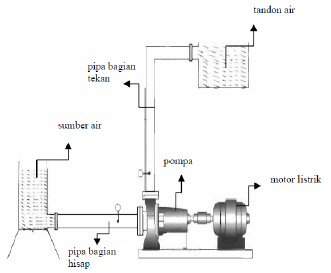
Figure 59. Pump Installation
b. Piping System on Centrifugal Pumps
Good or not working centrifugal pump depends on the selection and layout correct piping system. In general, the pump has a suction pipe and BIPA conductivity / waste.
– Suction pipe.
The suction pipe of a centrifugal pump has an important role in the success of the work of the pumps. Poor drafting of a suction pipe will cause the Net Positive Suction Head (NPSH) insufficient, causing vibration and noise due to blows (water hammer), wear and so on. Given the pressure at the pump inlet is suction (negative value) and the valve must be limited to avoid cavitation, it must be arranged so that a loss in the suction pipe as small as possible. For this purpose arranged so that the suction pipe diameter is large enough and avoided their turn.
– Pipe Conductivity
A unidirectional valve (check valve) must be installed on pipes carrying in a position close to the pump in order to avoid water hammer and manage the expenditure of the pump. The size and length of the pipe conductivity depending on the needs. Things that must be considered:
o Avoid any deviations or vortex flow at the suction nozzle
o Pipes should be as short as possible and the number of bends should be as little as possible in order to lose as little energy as possible
o Avoid terjandinya air pockets in the pipe by making the horizontal section of pipe slightly upward toward the pump with a slope of 1 / 100-1 / 50.
o Avoid leaks in pipe joints
o If the filter or the suction valve will be installed then it is necessary to provide a way to clean dirt clogging. This can be done for example by creating a suction pipe which is easily removable and not buried in concrete
o The depth of the pipe end: The tip of the suction pipe should be buried below the water surface to a specified depth to prevent terisapnya air from the surface (at least 60 cm),
c. pipe Exit
Exit pipe diameter is calculated based on economic calculation operation of the pump. In general, the flow rate of the pipeline is taken from 1 to 2 m / sec for small diameter pipe, and 1.5 to 3.0 m / s for large diameter pipes. Speed should not be more than 6 m / s for grinding will occur, thus accelerating the wear of the pipe. Usually the size of the pump is expressed by the capacity or discharge, and the size of the exit pipe. In general as a handle diameter discharge pipe and pump out as shown in Table 9.1 below.
Table 16. The handle general capacity of the pump is based on the pipe diameter exit

d. End of the pipe exit
For pumps with low head, the end of the exit pipe is generally made open to the horizontal direction, below the surface of the water in the sump. If the pump is to be installed on the face of the water tank, it should be made chiffon with exit pipe bend down.

Figure 60. Chiffon
e. leverage pipe
In the installation, the pipe must be riveted to withstand its own weight, the weight of the liquid in it, the style of pressure and water flow, and other styles. This pedestal should be installed such that the pipes do not overload the pumps and valves that exist.
f. Foundation
The foundation must be able to fully absorb the vibration of the pump and the driving force, in addition to be able to withstand its own weight. To pump which is coupled directly to the electric motor, heavy foundation must be more than 3 times the weight of the machine. To pump which is coupled directly to the reciprocating engine, heavy foundation must be more than 5 times the weight of the machine. If the pump is coupled directly to the drive or driven through the gears, then everything should be installed at one runway.
When used in transmission belt (belt), pump and motor DAPT fitted with a separate foundation. However, it must be maintained so that the belt does not slip or grounding is not tilted or shifted due to belt tension. So that the runway can sit horizontally with both the foundation, there must be a gap of 10 to 30 mm only between fields on a foundation with the foundation of the field. It is intended to be menyeletel flatness of the runway. After grounding adjustable flat on the foundation, then the gaps are filled with mortar.
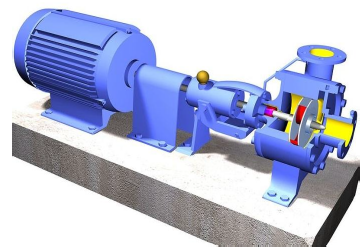
Figure 61. The cornerstone and foundation
