Parameter Irrigation Pumps
a. atmospheric pressure
Atmospheric pressure is the air pressure at any point on the Earth’s atmosphere. The air pressure in each layer mempersentasikan total mass of the airspace above those levels. Reduced air pressure at different altitudes. Although the air seems lighter, if it has a large column of air at the Earth’s surface would produce a pressure of about 100 kN / m2 or equivalent to 1 bar or 10 m water column
Atmospheric pressure = 100 kN / m2 = 1 bar = 10 m water column
b. debit
Speed or velocity is the rate of water flow per unit time in the pipe or channel expressed in units of m / sec. Debit is the volume of water flowing in pipes or channels per unit time is expressed by m3 / sec. For example in Figure 9.1 where the water flows in the pipe diameter of 100 mm at a speed of 1.5 m / sec. Then in 1 second amount of water will flow in a pipe with the same volume with which shaded in Figure 9.1. This volume is equal to the speed multiplied by the cross sectional area of the flow that is 1.5 x 0008 = 0012 m3 / sec.
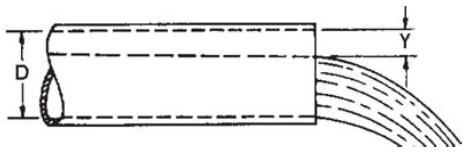
Figure 43. Measurement of discharge
The flow rate (m3 / s) = flow cross-sectional area (m2) x Speed (m / sec)
c. pump capacity
Capacity is the volume of water that comes out of the pump per unit time. Commonly referred to as flow rate, generally expressed in liters / sec or liter / min.
d. High Suction Static (Static Suction Lift)
Static suction height is the vertical distance from the pump shaft to surface water sources see Figure 44.
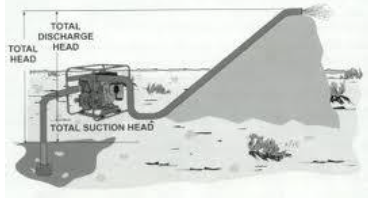
Figure 44. The pumping system where the source of water in the bottom center of the pump out by gravity
e. Total High-Sip (Total Suction Lift)
Number of high suction static with all the energy loss in the suction pipe (pipe, filter and foot valve) plus the velocity head on suction pipe.
f. High Press Static (Static Discharge Head)
High static pressure is the vertical distance from the pump shaft to the water level coming out of the pump see Figure 9.3.
– Total Head press (Total Discharge Head)
Total head press is a high amount of static press with all the energy loss in the form of pipes and pipe press smabungan plus velocity head and pressure head.
– Total Head
Total head pressure or energy to be supplied to the water pump which amount is the sum of the total head press with total suction lift.
– Total Static Head
Total static head is the vertical distance from the water surface on the suction pipe to the face of the water out.
– Head Friction (Friction Head)
Friction head is equivalent head expressed in meter water column to overcome friction in the pipe flow.
– Head Pressure (Pressure Head)
Pressure head pressure is expressed in meters of water column in an enclosed space where the pump sucking or pressing water (Hp = / g).
– Head Speed (Velocity Head)
Head speed (Velocity head) is the water pressure is expressed in meters column of water required to produce the flow rate. (Hv = v2 / 2g)
High maximum suction pump (practical maximum suction lift). For operational without cavitasi centrifugal pumps, high suction coupled with all the other losses should be smaller than the theoretical atmospheric pressure.
The maximum suction height calculated by the equation:
Hs = Ha – Hf – ice – NPSH – Fs
Where:
Hs = is the maximum suction height, or distance from the center of the pump to the water level (meters)
Ha = atmospheric pressure on the surface of the water (meter or 10.33 m at sea level);
Hf = frictional losses in filters, pipes, fittings and valves on the suction pipe (m);
es = saturated water vapor pressure (m);
NPSH = net positive suction head of pump was lost in the blades and the velocity head (m);
Fs = safety factor (usually taken about 0.6 m)
