Vector Data Definition
The main advantage of vector data format is the accuracy in representing point features, limitations and straight lines. This is very useful for analysis that requires precision positioning, for example on the boundaries of the cadastral database. Examples of other use is to define the spatial relationship of some features. Vector data is relatively more economical in terms of file size and precision in the location, but it is very difficult to use in computational mathematics.
Vector data is the shape of the earth are represented in points, lines, and areas. Line is a collection of several points, while the area is the area bounded by a line which starts and ends at the same point. While the raster data typically requires storage space larger files and lower precision location, but easier to use mathematically. The main weakness of vector data is its inability to accommodate gradual change.
a) Entities (geometries) Point
Entities point covers all the graphics objects associated with or geographical coordinate pair (x, y). In addition to the coordinates (x, y), associated with the geometry ‘point’, the data must also be stored in a manner to indicate the type of ‘titik’ her. For example, the ‘point’ can be a symbol that is not associated with any other information. Or, ‘point’ is a symbol that has ties to other data.
This data can include information such as the display size and orientation of the symbol. If the ‘point’ is an entity of text, then other data associated with this entity will contain information characters to be displayed, the font (style) is used, the text alignment (right, center, left), scale, and orientation.

Figure 3. Entity Point
b) Entities (geometries) Line
Entities line can be defined as all elements are built using the linear line segments formed by two coordinate points or more. The simplest line entities will require space to store the starting point and end point (two couples coordinate [x, y]) along with other information about the symbols that will be used to present it. For example, the parameters can be called to display the symbol of lines discontinuous (dashed) or not (solid) on the monitor display device.

Figure 4. Entities line
In relation to the vector data model entities geometries on the line, often used terms such as ‘arc’, ‘chain’, and ‘string’; which is a set of pairs of coordinates (x, y) which describes a continuous line which is complex. Shorter segments constituent lines, the more number of pairs of coordinates (x, y) is involved in it, and the more subtle form of curves (complex) which can represent.
Vector simple lines and the chain does not automatically bring inherent spatial information (attached automatically) regarding a connectivity or network (which may be required to meet the needs of network analysis creeks, roads, and transportation). Thus, to get a line network that can trace the computer software system line-by-line (or track-by-track), needed pointer in the vector data structure. Data structures involving pointers are often formed with the help of the node (s).
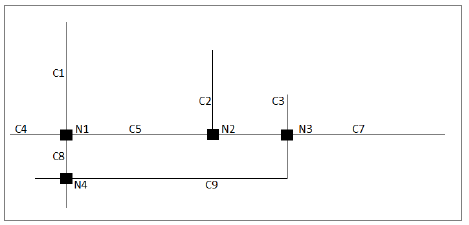
Figure 5. Structure of vector data
The picture above gives an illustration of vector data structures needed to define connectivity (relations) between all branches, creeks, or roads. In the structure of this vector are sepereti chain component (s) with the indices C and component node (s) with the index N. Besides the duty to bring the pointer (s) to some of the chain, the node (s) also (possibly) have data or information indicating large corner of each chain associated with the node concerned.
Thus, the node (s) and the arc (s) or chain (s) may define the topology of the network (network topology). Nevertheless, this simple structure connectedness still have some redundancy data because koordiant-ordinates of each node in the record as much as (nx chain (s) + 1) times, diaman n is the number of chain or arc associated with a node.
c) Entities (geometries) or polygon Area
Entities polygon is the area bounded by a line which starts and ends at the same point. Entities can also direpresentansikan polygon by utilizing a variety of ways on the model or the vector. Because most thematic maps used by SIG dealing with polygon geometry, the methods of representation and manipulation of entities of this type also received a lot of attention.
The structure of polygon data (implicitly) aims to describe the properties (that is topology) of an area (shape, relations of neighborhood and hierarchy) such that the attributes that are owned by the building blocks of spatial basis of this type can be displayed and manipulated as (data) thematic maps. Before describing more about how the polygon data structures can be built, the following described requirements (requirements) network polygon (polygon network) specified by the data geography:
First, each component of polygons (area, area, or region) on a map will have the shape, area, and perimeter unique. Here there is no single standard base unit as well (pixels) on the raster data model. Even on a site plan or streetplan regular and orderly in some building blocks though, is not true if the buildings are considered to have the same shape and size exactly. For maps of land-cover, soil type, geology and the like, similarity space, shape, and size clearly is something that is not possible.
Second, the spatial analysis of (certain) requires data structures (vectors) in question may also involve the (record) spatial elements and others to be “neighbors” every element of polygons just as well as elements of “tributaries” require connectivity in forming water transport network as a whole.
Third, each element of spatial polygon shape (in the thematic maps) may not necessarily be at the same level or entity. For example, it is a fact that there are several small islands (polygons) contained in a spatial element lake (shaped polygon) which is also located within a spatial element islands (polygons) is greater. Another example is an element of “parcels of land owned” (polygon) is located in a spatial element villages (polygons), elements of spatial districts (polygons), elements of spatial districts (polygons), spatial element provinces (polygons), and a spatial element state (polygon ) certain.
