Working Pump Positive
On a positive working pump fluid pressure increase in the pump room caused by the downsizing of the volume occupied by the liquid. The existence of elements that move in the room causes the volume of the room will be enlarged or shrunk in accordance with the movement of the element. In general, positive working pumps classified into:
a. Piston pump
The working principle of this pump is as follows rotation of the swivel casing will cause the piston to move up and down. Air is sucked into the cylinder and then rotated to exhaust the ups and downs due to movement of the piston. Meets cylindrical piston cavity on a swivel casing with a suction channel and press contained in berkatup tool. These pumps are manufactured to meet the needs of a very high head with low flow capacity. In its application piston pump is widely used for the fulfillment of a hydraulic power lift aircraft.
Its working principle is the piston motion suction valve open and closed press. While at the time the piston began doing press movement, the suction valve closed and valve open press. Then the fluid was sucked disposed in the valve tap. These pumps are used to meet the high head low capacity. In its application piston pumps are widely used for the fulfillment of hydraulic power.
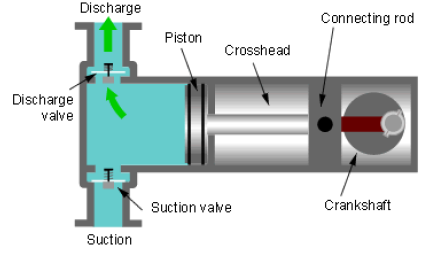
Figure 45. Piston Pumps
b. Gear Pumps
Is the principle of rotation of the two gear pairs are located between the pump housing and sucking and pressing the fluid that fills the room between the gear teeth and are limited by the pump house. Liquid is sucked pressed into the exhaust side as a result of being filled space between the gear partner. These pumps are typically used to meet the needs of high head with a flow capacity is very low. In its application, these pumps are used for lubrication.
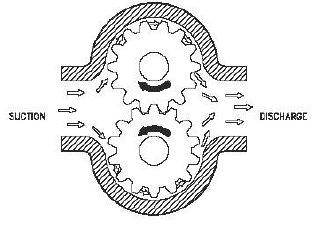
Figure 46. Pump Gear
c. Rado external gear pumps
On the outer gear pumps, rotors in the form of a pair of gears rotating within the pump housing. The gears that can be either single-helical gears, double-helical or straight teeth.
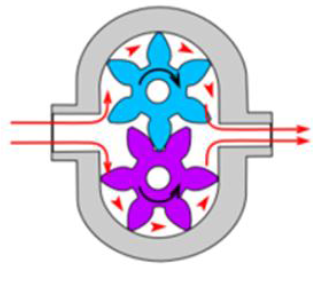
Figure 47. The external gear pump
d. Gear pumps in
Gear pumps have a rotor in the form of gears in pairs with a free outdoor gear (idler).
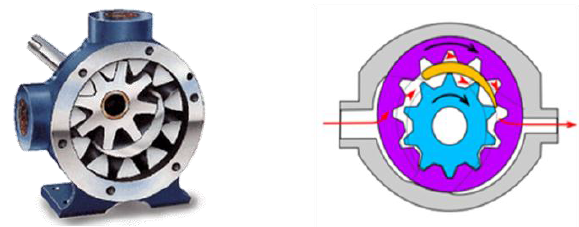
Figure 48. Pump gears in
Vane pumps, rotors rotating element mounted in the form of an eccentric with the pump housing. At around the rotor grooves are filled blades of the blade to move freely. When the rotor is rotated, the blades move in the radial direction due to centrifugal force, so that one end of the blade is always in contact with the surface of the pump housing to form barriers in the pump room.
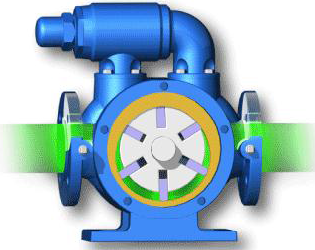
Figure 49. vane pump
