Types of Switches
Switches or switches are devices that act as connectors and circuit breakers. In electronic circuits and electrical circuits the switch functions to connect and disconnect the electric current flowing from a voltage source to the load (output) or from one system to another. The following are some types of switches based on the construction of each switch.

Top, from left to right: Circuit Breaker, Mercury Switch, Wafer Switch, DIP Switch, Surface Mount Switch, Reed Switch. Down, from left to right: Wall Switch, Miniature Toggle Switch, In-Line Switch, Push-Button Switch, Rocker Switch, Micro Switch.
Types, Symbols, and Sample Switches
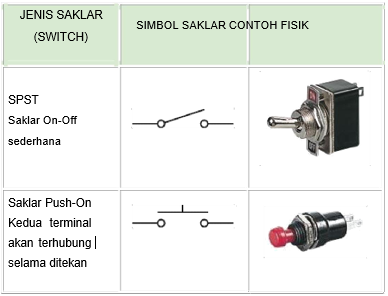

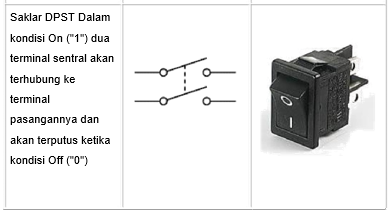
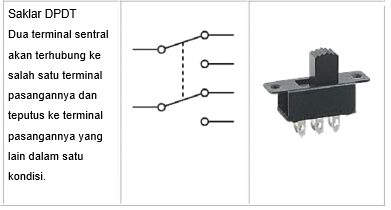
Information:
1. On: Connected Position
2. Off: Unconnected Position
3. Push: Press
4. Pole: Number of contactors
5. Throw: Number of Conductor Position (connected)
6. Open: Open (Off Position)
7. Close: Closed (On Position)
8. Break: Off (Unconnected Position)
9. SPST (Single Pole Single Throw)
10. SPDT (Single Pole Double Throw)
11. SPXT (Single Pole X Trow) X = Throw count, for example SP6T (Single Pole 16 Throw)
12. DPST (Double Pole Single Throw)
13. DPDT (Double Pole Double Throw)
14. DPXT (Double Pole X Throw) x = Throw count, for example DP4T (Double Pole 4 Throw)
15. Push Button Switch
16. Push Break Switch
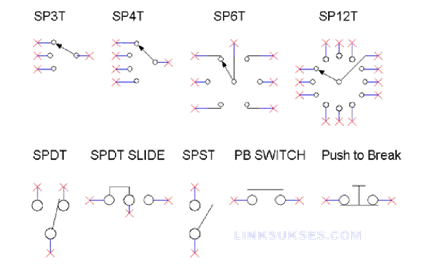
SPDT, SPST, Push-On, and Push-Off Symbols

DIP Switch symbol
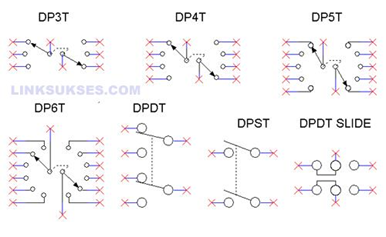
DPDT Switch Symbol
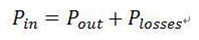
DC-DC converters act like transformers that convert a certain AC voltage to a higher or lower AC voltage. There is no increase or decrease in input power during the conversion of its electrical energy form, so ideally the power equation can be written with the following equation:
DC-DC converters can be divided into 2 broad categories, namely isolated and non-isolated. The word ‘isolation’ here simply means the use of a transformer (galvanic isolation) between the input voltage and the output voltage of the DC-DC converter. Some sources mention that the DC-DC converter is not isolated with the term direct converter, and an isolated converter with the term indirect converter.
