Pneumatic Basic Principles
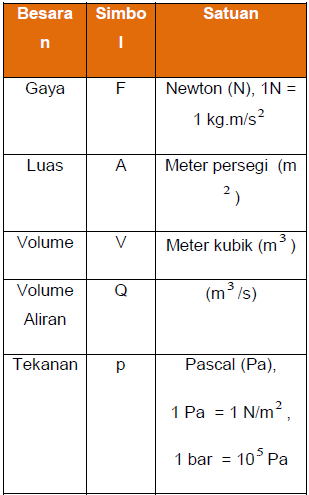
System Unit System units used in this book is the “International System of Units”, abbreviated SI. There are six basic quantities and units as shown in Table 1. Derived unit can be seen in Table 2.
Table 1. Basic Unit
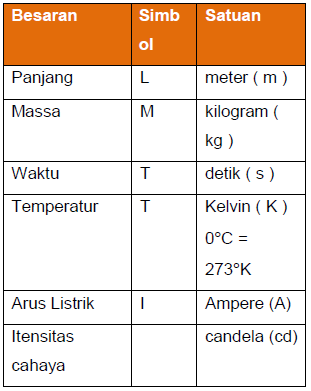
Table 2. Derivatives Unit
Pressure
Each of the force acting on an object’s surface will provide pressure. Similarly, if the force acting on a field, the style will put pressure. In addition to the solid, style is also putting pressure on the fluid, such as liquids and gases. The pressures generated on each of the different states of matter. It is influenced by the magnitude of the force and vast fields, where the style of work. If the force is working on a broad field, the pressure generated will be smaller.
Conversely, if the force acting on the narrow field of the resulting pressure will be greater. So we can say that the pressure is inversely proportional to the field of surface area. If the style of the work on an object, then the pressure on it is great. So we can say that the pressure is proportional to the force acting on it. The relationship between pressure with style and spacious field defined by the equation:

Where :
p = pressure (N / m 2), F = force (N) and
A = area (m 2)
Unit of pressure is Pascal (Pa). 1 (one) pascal is equal to the vertical pressure of a force of 1N in the field of 1m 2.

In use in industrial units of pascal is too small, so that another unit is utilized bar equal to 100kPa.
1 bar = 10 5 Pa = 100,000 Pa = 0,1MPa.
In countries that do not use SI units using other units are pounds-force per square inch (psi). If converted to a bar or pascal be as follows:
1 bar = 14.5 psi
1psi = 0.6895 bar = 0.7 bar = 7000 Pa
Since everything on this earth receives atmospheric pressure is absolute pressure (pat), then this pressure can not be felt. In general, atmospheric pressure is considered as a basic pressure, while varying (due to irregularities value) is:
Pressure gauge (relative pressure) = pg
Vacuum pressure = pv
This is illustrated in the diagram of Figure 7.1. Atmospheric pressure does not have a constant value. Variations in value depending on the geographical location and climate. The area of absolute zero line pressure until the line is called the vacuum atmospheric pressure and above the atmospheric pressure is the pressure area. Absolute pressure consists of the atmospheric pressure and the pressure measuring pat pg. The absolute pressure is usually 1 bar (100 kPa) greater than the relative pressure pg.
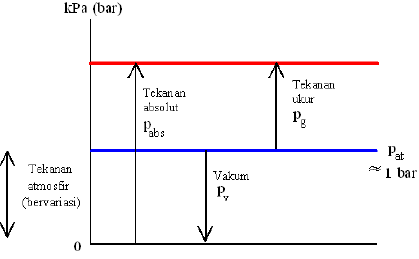
Image Air Pressure Relationship
