Irrigation System Selection Criteria
In planning for surface irrigation system there are some parameters that should be considered as inputs to select the surface irrigation system, namely,
1. The depth of irrigation water supplied.
This parameter is the amount of water that must be stored in the root zone of plants at the time given for the purpose of irrigation water to sustain plant growth to remain normal. Depth of irrigation water supplied is influenced by the following factors, namely the type of crop, the crop growth, whether there is a shallow water table, and a barrier layer such as layer padas land, where all of these factors will determine the effective rooting depth of the layer.
The type of soil is a factor that determines how much water can be saved per unit of soil depth. These factors, together with the climatic conditions of an area should be considered to determine the required number of applications.
2. Maximum allowable flow velocity (Vmax).
This parameter is used to estimate the flow rate of water that does not cause erosion. Vmax values are generally dependent on the type of soil, and can vary in the range of 8 m / min or 0133 m / sec for soil easily eroded to 13 m / min or 0216 m / sec for a more stable ground.
3. Manning roughness coefficient (n),
Manning roughness coefficient is a parameter in the equation is known Manning n value, is used as a measure of the effect of the channel resistance when water moves down the drain, wall or basin. Table 1 commonly used value of Manning, n in surface irrigation.
Table 1. Table Roughness Manning to channel
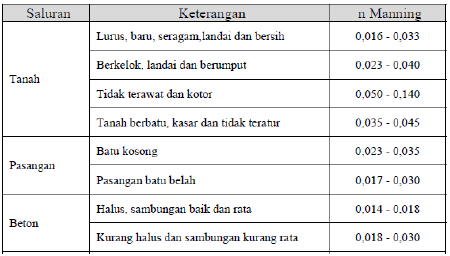
4. The slope of the basic channels (So).
Channel bottom slope or wall needs to be known to estimate the flow rate of non-erosive maximum and the flow cross-sectional area or depth of flow at each part of the channel is given by using the Manning equation. Channel bottom slope is the average slope in the direction of irrigation and is easily measured parameters.
For wall and channel slope groove should not be too high because it causes scours and should not be too low in order to reduce the effects of sedimentation and improve the efficiency of irrigation flow. Usually the value recommended by the USDA, which depends on the soil, the type and depth of the profile, a combination of plant and the size of the individual channels are used.
5. Rate of Infiltration (I).
Knowledge of soil infiltration characteristics are very important for the evaluation, design or management of surface irrigation systems. Therefore, the infiltration rate, determined before designing the irrigation canal.
