Electric Current
Electricity has been around since the existence of this universe, even when life on this planet does not exist. Very strong lightning bolts can light up the sky. Lightning is a natural phenomenon that indicates the existence of electrical energy. In line with the development of life, electricity became a very important part in human life. Almost all equipment used by humans utilize electrical energy assistance.
Electricity is basically divided into two kinds, namely static electricity (related to the electrical charge at rest) and dynamic power (related to electric charges in motion). At the time of the switch in an electrical circuit is closed, the light goes on, and vice versa when the switch is opened the light goes off. Why is that?
Electricity is formed due to the mechanical energy from the generator which causes a change in the magnetic field around the coil. This change causes the flow of electrical charge on the wire / conductor. The flow of electrical charge on the wire You know as electric current. Flow of charge can be either positive charges (protons) and negative charge (electrons). The electrical current flowing in the conductor can be either direct current or direct current (DC) and can be either an alternating current or alternating current (AC).
Basically the electrical circuit is divided into two, namely the electrical circuit is open and a closed electrical circuit. Open electrical circuit is a circuit that is not connected to the source voltage, whereas a closed electrical circuit is a circuit that is connected to a voltage source.
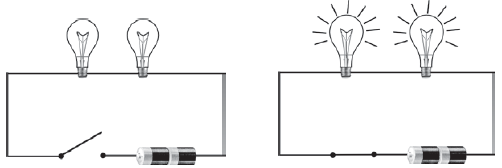
a. Open circuit b. Closed circuit
Image. 1:10 The electrical circuit
At a closed electrical circuit, in the flow of electrical charges. The flow of positive electric charge is identical to the flow of water. Consider the following picture:
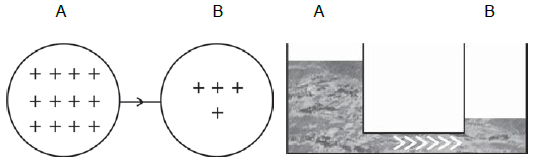
a. Electricity AB b. Water flow
Figure 1.11 The flow of positive charge from A to B is identical to the flow of water from A to B
The water in the vessel A has a higher potential energy than the water in the vessel B, resulting in the flow of water from the vessel A to vessel B or said that at a higher potential than the potential at B resulting in the flow of electric charge from A to B. So, can said that the positive electrical charges flowing from a point of high potential to the low potential point. Furthermore, the flow of positive charge is called electric current.
Thus, electric current can be defined as a flow of positive charge from high potential to low potential. Electric current occurs when there is a potential difference. What if two points are connected have the same potential? Certainly there is no flow of positive electric charge or electric current does not occur. You must be thinking what about the negative electric charge? Is a negative electric charge can not flow?
In further developments, after the electron was discovered by physicist JJ Thompson (1856-1940), was the charge that flows in a conductor is not a positive electric charge, but negative electrical charges called electrons. Direction of the flow of electrons from low potential to high potential (opposite to the direction of flow of positive charge). But this does not make a problem, because the number of electrons flowing in a conductor equals the number of positive electric charge that flows only in the opposite direction.
Thus, the electrical current still defined by the flow of positive charge are called conventional current.
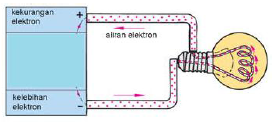
Figure 1.12 Flow of electrons
