Voltage Boost Topology (Boost Converter)
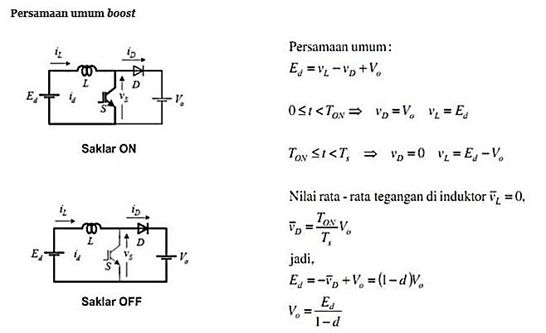
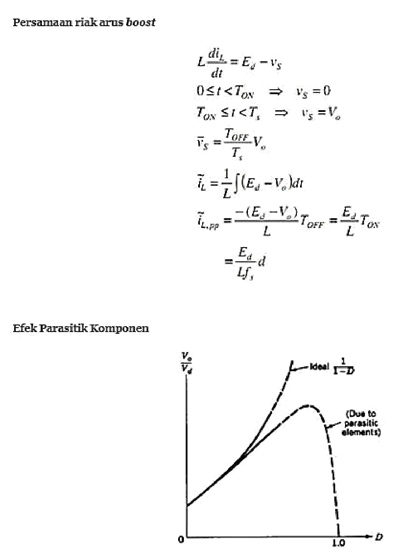
Boost converter serves to produce a higher output voltage than the input voltage, or so-called voltage boost converter. This converter is widely used for applications of solar and wind turbine power plants. This type of converter scheme can be seen in Fig. 3 and Fig. 4, where the main components consist of MOSFETs, diodes, inductors, and capacitors. If the MOSFET switch is closed, the current will flow to the inductor, causing the energy stored in the inductor to rise.
When the MOSFET switch is open, the inductor current will flow to the load through the diode so that the energy stored on the inductor will drop. The ratio between the output voltage and the input voltage of the converter is proportional to the ratio between the switching period and the opening time of the switch . The advantage of the boost converter is that it can generate a continuous input current.
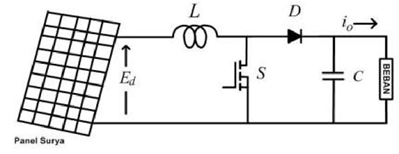
Boost DC-DC Type Boost Converter
Since the converter input current can be maintained continuously, when this converter is coupled with a diode rectifier, this converter does not generate harmonics on the diode rectifier source stream. Or in other words, the source current has a sinusoidal approximate waveform with a power factor equal to one.
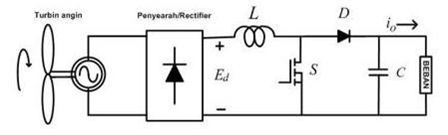
DC-DC type boost converter circuit + diode rectifier (power factor one)