Category: English

  • Plankton in Water

    Generally the presence of plankton in the waters will be affected by the type of waters (flowing or stagnant), chemical quality Dahn physics waters (eg temperature, brightness, flow, pH, CO2 content is free, etc.) and their competitors plankton predators.

    In the stagnant waters where plankton will vary from time to time and different in occupied space or body of water, while the water flowing elements of time and space are relative no real role. This causes the sample to observations of aquatic biological parameters vary.

    Water sampling for observation plankton parameter consists of several methods:
    a. filtration (filtration method) using a plankton net with mesh sizes adjusted to the desired plankton classification. the amount of water being stored varies 5-50 l depending on the density of plankton that can be seen from the color of the water. Samples were taken using a sampling tool with a certain volume, then filtered using planktonnet. plankton samples deposited in the filter was transferred into the collection bottles and then preserved using formalin or alcohol prior to the identification of plankton under a microscope.
    b. settling water sample (sedimentation method) using the tube container
    c. The centrifuge method is less desirable because it is not portable

    Observations plankton as a biological parameters generally include plankton diversity and abundance of plankton contained in a body of water. calculation of the abundance of plankton can use:
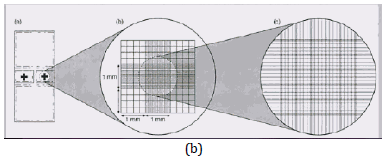
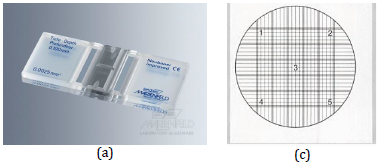
    (1) Haemocytometer, observations with this instrument is intended for phytoplankton or microscopic plankton, on a microscope with a magnification of 100 x. Usually used for computation (counting) Phytoplankton with size <10 lm.
    image

    image
    Figure 34. Haemocytometer (b) magnification cross-section to calculate the plankton samples (c) the observation point plankton abundance

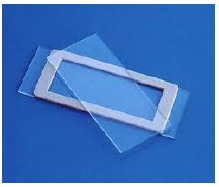
    (2) Sedgwick rafter cell, observations with this instrument is intended for Mikrozooplankton and phytoplankton by using a binocular microscope magnification 100
    image
    Figure 35. Sedgwick rafter cell

    Saedgwick rafter plankton observation cell is a device most commonly used for identification of plankton, because it has a relatively larger capacity, so it can be used for identification of phytoplankton and zooplankton are microscopic. Volume Sedgwick rafter proper cell 1 (one) cc or 1 cm3, comprising a length of 50 mm, a width of 20 mm and a thickness of 1 mm.

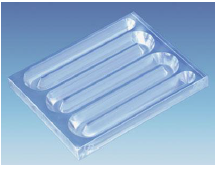
    (3) Bogorov tray, observations with this instrument is intended for zooplankton using a binocular microscope magnification 40 x, volume bogorov tray in one observation ± 6 ml.
    image
    Figure 36. Bogorov tray

  • Definition of Composite Paper

    Composite paper is paper that is processed together with other packaging materials such as plastics and metals, which aims to improve the brittle force, stiffness and strength of the material. Paper mixed with metal and formed into a kind of cans called composite cans, used for citric juice, spice containers (spices), chocolate boxes, dry soups, chemicals and medicines. The packaging industry has made composite cans that can withstand vacuum and withstand temperatures of about 49 o C, so it can be used for preserving jam (jam). Tube carton is used for margarine and ice cream.

    There are 3 (three) types of construction of composite paper cans, namely: spiral shape, sewn lobe ( lap seam ) and compound roll ( convolute ). The spiral shape consists of several layers of different materials with an overlapping connection angle. Body composite lobe in sewing, made of laminated material, while the type of composite roll consists of several layers of coils. The carton tube is a tube-shaped package of cardboard or paper.

    The larger tube shape is called the carton drum. Tube cartons are widely used for packing chips, while drum cartons are used for powdered materials or dry products. For packing of liquid material then carton packing coated with plastic.

    The advantages of composite tubes and cartons are light weight, easy to open and close, can be re-coated with other materials so impermeable. Usually made in the form of folding / cardboard folding folds made of duplex material and the like, the thickness of the duplex is adjusted to the weight of the product or the thickness as well as the main attraction. With the development of packaging technology, cardboard packaging has good moisture resistance and can be designed according to the nature of fresh fruit.

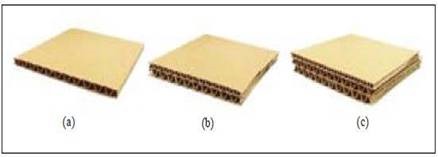
    The technology is adopted from the packaging technology of seafood products. Packaging from local materials made of paper remains in good condition even though placed in a room with moisture up to 80% (Trubusid, 2008). Based on the dimensions of the grooves, flat cardboard sections, and the number of plots, corrugated cartons are divided into several types, namely (International Trade Center UNCTAD / WTO 1993) .:

    • · The carton is not flat
    • · One-faced carton,
    • · Single wall double wallboard,
    • Double wall double wallboard,
    • Three double-wall double-walled cartons
  • Working Mechanism Filter “Under Gravel”

    As the name implies filter “under gravel” is a filter which is located below a layer of “gravel” (gravel, sand) at the bottom of the aquarium. Its construction consists of a layer of anti-rust material (plastic) perforated with bearing feet so as to create free space underneath to allow water to flow (Figure 5). In one of its corners (or more) are piping the output to return the water into the aquarium filtration results.
    image
    Figure 5. Example of Construction Filter “Under Gravel”.

    image

    Figure 6. Mechanism A Filter “Under Gravel”

    Figure 6 shows the mechanism of action of a filter “under gravel”. In this case the water was “forced” to break through layers of gravel at the bottom of the aquarium with the help of head pump or aerator, then the water is returned into the aquarium. At the time of water through water gravel undergo at least two filtration processes, namely mechanical, through the pores effectively gravel layer, and biology, through the contact of water with ammonia and nitrite-degrading bacteria that live on the surface of the gravel.

    Biological filtration systems play a major role in this filter. Over time, the buildup of solid particles in the space between the gravel can cause a blockage. Therefore, under gravel filter is recommended for in-patient periodically, at least by estab-vacuum-an on gravel. Blockage can lead to a condition anaeraobik on gravel environment that can lead to bacterial decomposition of ammonia and nitrite die which may eventually result filter malfunction.

    Under gravel filters are often used especially in the marine aquarium. In this filter system, organic particles are trapped on the surface of the gravel will be a source of food for microorganisms (plankton). Furthermore plantkon be a source of food for other marine inhabitants are maintained, particularly from the class of plankton. Thus, the filter “under gravel” in the marine aquarium as if it serves also as a refugium.

    Under Gravel Filter Reverse (Reverse Flow Under Gravel Filter)
    One of the problems in using under gravel filter is likely to be blockage of the flow as a result of the accumulation of dirt that can not be processed quickly. This debris can accumulate between the gravel, causing blockage which in turn can reduce the performance of the filter. One solution is to relatively frequent menyipon and clean the gravel layer on a regular basis. The cleaning should be done partially, so that bacterial decomposition is not exhausted “washed away”.

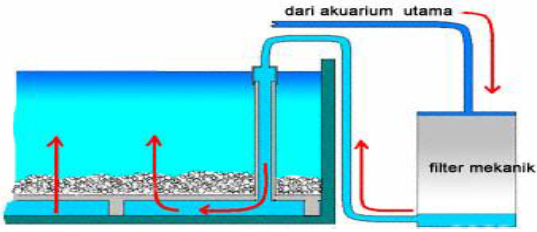
    Another way is to separate the sediment from the gravel. This can be done using methods fiter under gravel with the flow reversed. Figure 7 shows a diagram of how the separation is made. The separation of the deposition process is done by adding a filter unit outside the main aquarium. The main task of this filter is to perform mechanical filtration (A canister filter may be used to perform this task).

    After a mechanical filtration process, the water is then returned (with the aid of a pump) into the main aquarium via pipes let out under gravel filter. Furthermore, the water will spread out below under gravel filter and then through the layer of gravel. At the time through the gravel layer is water undergoes biological filtration process. Thus when water is back in the main room of the aquarium is expected to have been freed from ammonia.
    image
    Figure 7. Filter under gravel with water flow reversed.

  • Use of Pallets In Distribution

    The packaging size for exported products needs to consider the ease of transport, especially for commodity loading and unloading processes during distribution using pallets and forklifts (Anonymous 2008). The palette is a medium for moving large quantities of goods in one unit from one location to another efficiently. Developed countries have used pallets to support efficient product distribution by loading and unloading systems in one unit.

    Pallets have an important role in the distribution because it facilitates the process of moving goods to trucks or containers, both with human power and with forklifts . The ISO standard recognizes six pallet sizes as the standard size in the world, namely:

    • · 1,067 mm x 1,067 mm,
    • · 1,100 mm x 1,100 mm,
    • · 1,140 mm x 1,140 mm,
    • · 1,200 mm x 800 mm,
    • · 1,200 mm x 1,000 mm, and
    • · 48 “x 40” (1,219 mm x 1,016 mm) (Anonymous 2008b).

    Each Country selects a standard pallet size for different reasons. The standard pallet sizes used in some countries are presented in Table 7.

    Table 4. Several Palette Sizes according to ISO for Loading and Unloading System of Goods and Country Users

    Palette Size (mm) User Country
    1200 x 800 Europe, Singapore and China
    1140 x 1140 Some European countries, China
    1200 x 1000 Germany, Netherlands.Taiwan, Singapore,
    Thailand, China, Indonesia
    1219 x 1016 America, China
    1067 x 1067 America, Canada
    1100 x 1100 Japan, Taiwan. Korea, Singapore,
    Thailand
    Source: Lee (2005b)

    In Asian countries, the pallet size used varies considerably, although some of them have used the ISO standard. The recommended palette standard for grocery and fast moving consumer goods industry in Asia is 1,200 mm x 1,000 mm, however The size is not widely used. With different cardboard packaging sizes, the efficiency of pallet usage will also vary. Efficient use of the ideal pallet area is 100%.

    According to Lee (2005a), the efficiency of 90% or more pallet loading is called good fit, 80% efficiency including average fit, and load efficiency of 70% Classified as poor fit. Figure 3 provides an illustration of the packaging arrangement in the palette to obtain maximum efficiency.

    Packaging materials commonly used in the fishing industry of fresh fish and frozen fish products exported include: cold-resistant plastic, wax-coated cartons and styrofoam. To know more about the type of materials commonly used by the fresh fish processing industry and frozen fish, let us do the observation of the packaging materials used by the fish processing industry around your area.

  • Styrofoam Packaging

    Styrofoam or plastic foam is still tergoloug plastic family. Styrofoam is commonly used as a protective and fragile retaining material for fragile items such as electronics. However, today the material becomes one of the preferred food packaging and drinking materials. The basic ingredients of Styrofoam are polisterin, a type of plastic that is very light, stiff, translucent and cheap but quickly brittle. Because of its weakness, polisterin is mixed with zinc and butadiene compounds.

    This causes the polisterin to lose its clear nature and change its color to milk white. Then for elasticity, there is added a plastiticizer such as dioktyl pthalate POP), butyl hydroxy toluene or n butyl stearate . Plastlk foam that easily decomposes into small cell structures consumes blowing process by using chlorofluorocarbon gas (CFC). The result is a form like that is often used today.

    Styrofoam or foam plastic is one of the plastic types of So many other ingredients. Styrofoam is commonly used as a protective and retaining material for fragile goods , such as electronics. However, at this time the material is also widely used as a food and beverage packaging. The use of styrofoam as a food container raises concerns and protests from various parties.

    Based on various studies conducted since the 1930s, it is known that styrene, the basic ingredients of styrofoam , are mutagenic (capable of altering genes) and potential carcinogens (stimulating cancer cells). Similarly , butadiene as a reinforcing material or DOP or BHT as plasticiser it. Such materials, especially styrene, water-soluble, fat, alcohol, or acids. The longer the time of dumping and the higher the temperature, the greater the migration or movement of the toxic substances to food or drink. Especially when the food or drink that contains lots of fat or oil.

    Indeed the induced toxicity is not immediately apparent. It is accumulative and in the long run there are new consequences. Meanwhile, CFC as a blowing agent in the manufacture of styrofoam is a gas that is non-toxic and flammable and very stable. Once stable, this new gas can decompose about 65-130 years. This gas will float in the air reaches the ozone layer in the atmosphere and will react and break down the protective layer of the earth. Due to breakage of ozone layer, will emerge greenhouse effect. Earth’s temperature increases, sun’s ultraviolet rays will continue to penetrate the earth, causing skin cancer.

    The polystyrene foam packaging is chosen because it is able to maintain the hot / cold food, remain comfortably held, maintaining the freshness and integrity of the packaged, light, and inert food to the acidity of the food. Because of these advantages, polystyrene foam packaging is used to pack ready-to-eat foods, fresh, or that require further processing (BPOM, 2008).

  • Corrugated Cardboard Packaging

    More than 90% of corrugated cardboard packaging produced is a single wall double carton type. Double wall double wallboard is commonly used to pack heavy items, especially for export, while double wall triple cartons are used to pack heavy industrial items. Based on the construction, there are several types of corrugated cardboard packaging, namely:

    • · Type of cut printing,
    • · Type bliss
    • · One-piece box type
    • · Lock type
    • · Type of telescope

    The most widely used type of corrugated cardboard packaging is the type of onepiece box with regular slotted container (RSC) type . This type has the same long cap and meets in the middle when closing. According to International Trade Center UNCTAD / WTO (1993), RSC type is the most economical because the material used is minimal but the volume is maximal (Figure 36).
    clip_image002
    Figure 36. Some Kinds of Corrugated Carton (Anonymous 2008a);
    A) Single wall,
    B) Double walls, and
    C) Three walls

    clip_image004
    Figure 37. Corrugated Carton Package Type One-Piece Box with Regular Slotted Container Type (Wikipedia, 2008).