Category: English

  • At The Bacteria Attack Seaweed

    Bacteria which can be isolated from the seaweed with ice-ice symptoms include Pseudomonas spp., Pseudoalteromonas gracilis, and Vibrio spp. Agarase (arginase) of bacteria is one of the virulence factors that contribute to infection ice-ice (Yuan, 1990). Predisposing factors or other triggers may also cause ice-ice. Predisposing it include pests such as fish rabbitfish (Siganus spp.), Green turtle (Chelonia midas), sea urchin (Diadema sp.) And starfish (Protoneostes) that causes injury to the thallus.

    The wound will lead to secondary infection by bacteria. The growth of bacteria in the thallus will cause part of the thallus becomes white and brittle. Furthermore, the piece is easily broken and become soft tissues. Infection ice-ice attack on the base of the thallus, stems and young thallus tip, causing the network becomes white. In general, spread vertically (from seed) or horizontally through the medium of water.

    Infection will gain weight as a result of the attack epiphytes that block sunlight penetration because seaweed thallus can not perform photosynthesis. Darmayanti et al., (2001) also explains that the sample taken from the seaweed cultivation Kappaphycus alvarezii, whether sick or healthy bacteria are vibrio group of species of Aeromonas sp. Largo et al., (1995) in research on the cultivation of seaweed Kappaphycus and Eucheuma genera in the Philippines found the bacterium vibrio group and Cyatophaga-Flavobakterium more dominant.

    Aside from the stretcher group also found the bacteria Aeromonas at (Sargassum and Thalassia). From the results of these studies there is a competition between the bacteria on certain conditions in the environment that can cause disease. Uyenco et al., (1981) suggests that the ice-ice disease arises due to the decrease in intracellular protective substance when kelp experience stress environment. Some researchers say that the incidence of the disease in seaweed due to changes in the environment that is decreasing salinity and light intensity.

    In general, ice-ice disease that attacks the cultivation of Eucheuma striatum in Southeast Maluku that the emergence of ice-ice disease occurs at the beginning of the season the west (the change of seasons east to west).

    image
    Figure 25. The disease that attacks the cultivation of seaweed

    The density of bacteria in diseased sea grass is 10-100 times more than the density of bacteria in K. alvarezii healthy. Largo et. al. (1999) also explains the mechanism of infection, where the vibrio bacteria stick to the seaweed thallus that stress, then multiply the cell wall by using polysaccharides (carrageenan) as a medium or a source of carbon. After 2-3 days vibrio into the network until the medullary layer by means of hydrolyzing enzymes karaginase (Lin in Weinberger 2007), as a result of macro algae cultivation Kappaphycus alvarezii thallus color becomes pale / white, soft tissues and thallus easily disconnected.

  • Measurement of Erosion and Sedimentation

    Equipment used in the measurement of sediment transport (sediment transport) is based on the standard United States. Geological Survey (USGS), the equipment has been developed by the Federal Inter-Agency Project sedimentation (FIASP). Gauge / sampling sediments that have been standardized by FIASP, has a specific code that can be interpreted as follows:
    US: gauge / sediment sampling with standard United States.
    D: Integration into the depths (depth integrating).
    Q: Integration Point (point integrating).
    H: Hanged / held with a stick / stick / handlebar or rope, while suspended by cables / sounding, reel, without code / letter H.
    BM: Material basis (Bed Material)
    U: Standard Single (Single stage).
    YEAR: Year of manufacture / developed (written, the last two digits).

    Here is described one piece of equipment to take samples of sediment discharge float, ie the depth integrating sampler. This tool is designed in such a way in order to capture the flow of water mixed with sediments in the upright position and speed of the flow of the incoming flow to the nozzle will have a value anywhere near the speed of flow around it. This tool is used in a way down to the bottom of the river and picked up close to the surface with the velocity of the same. One type of this measure is commonly used, namely the US D-48.
    image
    Figure 5. Depth 48 integrating sampler

    USLE Integration with Geographical Information Systems (GIS)
    USLE was developed to estimate the lost ground on the land with a small size, so that in its application for estimating sediment Yil (not losing ground) basin, all factors (except R) should be calculated by weighting. Furthermore, if the land use or practical conservation in the watershed varies over space, erosion must be calculated individually for each area, and also required modification factors USLE price.

    The most appropriate way to accommodate the characteristics of each spatial extent is the application of Geographical Information Systems (GIS). The use of Geographic Information Systems as a system of data collection organized today began to grow rapidly. And this has been proven in several agencies both public and private that uses Geographic Information Systems as a collection system and a unified data integration.

    There are some interesting things why the concept of GIS is used, even in a variety of disciplines. Among them;
    1) Almost all operations (including analysis) owned by interactive GIS devices are supported with easy to access menus (user friendly).
    2) ability to decipher the entity that is in the earth’s surface on a spatial data layer format. Thus the surface can be reconstructed or modeled in the form of a real using elevation data and thematic layers required.
    3) Applications – GIS application provides the facility to be customized with the help of scripts language program owned software SIG or even able to integrate with the other applications that are compiled with the programming language that is more sophisticated (Visual Basic, Delphi, C ++).
    4) Software GIS provides the facility to communicate with applications – other applications to be dynamically exchange data either through the facilities of OLE (Object Linking and Embedding) ma upun ODBC (Open Database Connectivity) to access remote data. Additionally SIG has been widely implemented in the form of software components that can be reused by the user who wants a digital map display (especially vector format) on the application with the ability and quality standards.
    5) At this time the user is at a remote location from the data source to access GIS data by implementing GIS map-server or server-ready to serve requests (queries) the client via the intranet or the Internet (web-based).

    So that the workload can be separated between the client and the server. In addition, the application of GIS-application can be made on the server or on the client. Server will organize and provide services to all incoming queries from users (clients).

    Thus the product of GIS application can also be freely published on the Internet to be accessed using an Internet browser application. Thus for managing these complex data, required an integrated information system that is capable of processing both spatial data and attribute data to further be able to answer the question of spatial and attribute simultaneously. It is expected that the existence of an information system that is efficient and capable of managing data with complex structure and a large amount of these can help in the decision making process.

  • Water Temperature Ideal For Water Organisms

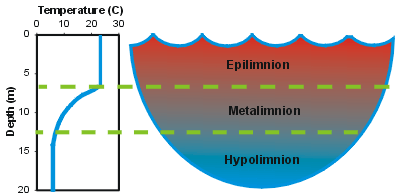
    The ideal water temperature for aquatic organisms are cultured should happen is not striking the temperature difference between day and night (no more than 5 ° C). On the stagnant waters which have a minimum water depth of 1.5 meters will usually happen coating (stratification) temperature. This happens because the coating surface temperatures higher than the temperature of the water at the bottom.

    In the stagnant waters, based on differences in heat at any depth, water can be grouped (stratified) into three, namely:
    a) epilimnion layer, the upper layer of warm water with a relatively small drop in temperature, the entire future water well mixed because of the wind and waves
    b) the thermocline layer or metalimnion, which is the middle layer which has a very sharp drop in temperature, in this area every additional depth of 1 m, the temperature will also be reduced by 1 ° C
    c) hipolimnion layer, which is the bottom layer which is padalapisan temperature differences are very small and relatively constant. on this layer hardly occurs mixing of water masses so that the temperature is relatively cold.

    image
    Figure 5. Stratification of stagnant waters based on the temperature difference

    The temperature stratification occurs due to the influx of heat from sunlight kedalamkolom water resulted in a temperature gradient vertically. At the pond water depth of less than 2 meters usually occurs unstable temperature stratification. Therefore, for the fish farmers who undertake activities budidayaikan water depth should not lebihdari2 meters. In addition to break down the temperature stratification in the container of fish farming needed a tool by using an aerator / blower / waterwheel.

    These properties are unique properties of water and are very important in the spread (dynamics) of heat in the water. With properties unique water, then the water supports:
    a) The life of the organism in winter, because the water just freezes on the surface.
    b) With temperature changes slowly, aquatic animals able to adapt to any changes in the properties of water.

    Heat source that greatly affect the temperature of the water mainly from:
    a) The radiation (radiation) directly from sunlight.
    b) Condensation (Pengembusan) of water vapor.
    c) The heat from the bottom waters (the center of the earth).
    d) The effect of heat from the atmosphere.
    e) The heat from the chemical processes in water.

    Being the factors that affect the decline in water temperature is in general from:
    a) Evaporation (evaporation).
    b) reflection / heat release back.
    c) reflection of sunlight back into the atmosphere from the water surface.

  • Physical Parameter Water Quality

    Aquatic environment as a place to live or live media aquatic organisms is one of the most important aspects to consider in doing aquaculture. This is because the quality of the waters of a container cultivation largely determines the life of aquatic organisms cultivated, both from the aspect of water resources which are used as parameters of physics, chemistry and biology, it is also necessary to know and understand the aspects required in the management of water quality.

    Physical parameters are parameters that can be observed as a result of physical changes in water such as light, temperature, brightness, turbidity, color, suspended solids and dissolved solids to water salinity. While chemical parameters of waters are waters measured parameter due to a chemical reaction in water, such as the exchange of ions dissolved in water. The observed biological parameter waters are aquatic organisms that live together in waters crops are plants and animals with a form of micro and macro.

    Physical properties of water is a factor of separation between the aquatic environment with air environment. Besides physical factors also affect the lives of many organisms in the water. The existence of huge differences of each physical factor in the aquatic environment with air environment, results in a different effect on plants and animals in each of these environments. In addition, water also serves to maintain the osmotic pressure, as a solvent and a good conductor of electricity.

    Water colors
    Color can inhibit the penetration of light into the water. Colored sea water by natural processes, both derived from the biological and non-biological. The product of a biological process can be humus, peat and others, while the products of non-biological processes can form chemical compounds containing elements Fe, Ni, Co, Mn, and others. In addition, sea water discoloration can be caused by human activities that produce colored waste. Sea water with a certain color levels can reduce photosynthesis and can disrupt aquatic biota, especially phytoplankton and some types of benthos.

    Water color on a body of water that we see is a:
    a) File a light that is not absorbed and out the back of the waters.
    b) The color caused by materials that hovered in the form of organisms and inanimate objects. Colorful water such as: blue, green, yellow green and brown color.

    image
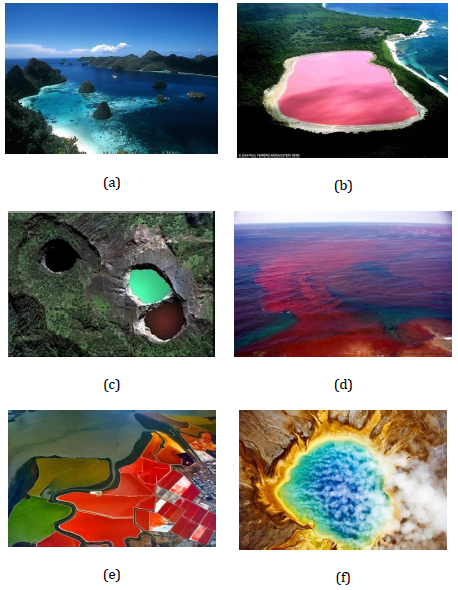
    Figure 1. A colorful public waters (a) Coastal Raja Ampat, Indonesia (b) Lake Hiller, Australia, (c) Lake Flores, NTT Indonesia, (d) La Jollla Beach, San Diego, (e) saltwater in San Francisco Bay and (f) hot springs The grand prismatic spring in the United States.

  • Seaweed Management

    To ensure kebehasilan seaweed farming it must be done rigorously maintained during the growth period, not only to plants themselves but also cultivation facilities were used. Therefore the role of the manager (cultivators) seaweed is necessary to minimize the possibility of damage khsusunya unpredictable forces of nature.

    In the maintenance of seaweed there are some problems that are often faced by seaweed farmers, among others:
    1) Damage caused by the construction of the plant and the current movement of the waves and the destruction of the fishing with nets or explosives or toxic materials.
    2) The condition is called “ice-ice”. Ice-ice often wrongly interpreted as a disease, but actually it is a symptom of stagnant water and rising temperatures.

    3) fish that eat the seaweed and epiphytic plants (various types of algae growing on seaweed)
    4) The lack of planting material or a good seed.
    5) physiological damage as a result of the flow of fresh water.

    While the cultivation of Eucheuma on the beach / ocean, waves and currents bring nutrients will play. But besides that, it will bring the solids particles will stick to the seaweed thallus that would interfere with the process of photosynthesis. In addition it will also inhibit the attachment of biofouling process of growth of seaweed as food than as filters can also block the light intensity into seaweed.

    Maintenance which includes the supervision and maintenance of both cultivation and plant construction should be carried out continuously so that the successful cultivation of the maximum. Construction of cultivation must be maintained from the damage caused by natural or decrease if the durability of materials. Large waves can cause uprooting stakes, anchors and rope breaking ris and the main ris. Any damage that occurs due to the influence of wind and waves, like the construction damage or raft position, straps are loose or broken, immediately corrected.

    Cleaning of waste or various tacks on the raft and the seaweed was also carried out on the same occasion, and where necessary seeds are damaged or detached from the bond is replaced with a new one. Observation and treatment carried out with a frequency between 3 times a week up to 1 week. The more often done in the field of controlling the sea grass plants will also be more awake quality and quantity.

    image
    Figure 15. Maintenance of seaweed planted with basic methods

    The reduced durability of materials and knocked stakes, raft or rope break or ris ris main. In order maintenance should be performed daily supervision and improvement of damaged parts immediately. Delays in repairs causing bigger losses due to the increasing number of plants are lost.

  • Effect of Temperature on Quality of Water

    The intensity and quality of light that goes into the water and are absorbed produces heat. From the point of ecological, thermal energy and its relationship with the things that happen in the water, is a very important factor in maintaining water as a living environment for animals and plants. Temperature is an important physical factor everywhere in the world. The increase in temperature accelerates chemical reactions; The law according to van’t Hoff temperature rise of 10 ° C will double folding reaction speed, although this is not always applicable law.

    For example, the process of metabolism will increase as the temperature rises to a peak and then declined again. Any changes in temperature are likely to affect many chemical processes that occur simultaneously on the network of plants and animals, thereby also affecting the overall biota. In the process of egg hatching temperature affects the length of time of incubation of eggs, for example in fish hatcheries higher the water temperature, the faster the incubation time. At a temperature of 29 ° C incubation period of 27-32 hours and at a temperature of 31.5 ° C incubation time from 20.5 to 22 hours.

    image
    Figure 4. The relationship between water temperature and time of incubation

    Temperature is one of the parameters measured water often, because of their usefulness in studying the physics, chemistry and biology. The water temperature varies with the circumstances of space and time. Temperatures tropical waters are generally higher than the temperature of the main sub-tropical waters in winter. Deployment in open water temperatures mainly caused by the movement of water, such as currents and turbulence. Molecular hot deployment can be said to be very little or almost nothing (Romimohtarto, 1985).

    The properties of this water heat affecting aquatic environments consist of:
    a) Heat types
    Water is one of the substances that have a high specific heat, which is very good for the environment. This type of heat is a capacity factor of heat energy to raise the temperature of a unit weight on a scale of 1ºC.

    b) Temperature
    Temperature directly or indirectly greatly influenced by sunlight. Heat possessed by the water will experience a gradual change between day and night and from season to season. In addition, water has the properties where the maximum density occurs at a temperature of 4 ° C and not at the point of freezing. The water temperature affects the amount of oxygen dissolved in the water. If the temperature is high, the water will be quickly saturated with oxygen compared with a low temperature.

    The water temperature in a body of water can be affected by season, latitude (latitude), elevation above sea level (altitude), time of day, cloud cover, the flow and depth of water. Increased water temperatures lead to increased viscosity, chemical reaction, evaporation and volatisasi as well as a decrease in gas solubility in water such as O2, CO2, N2, CH4, and so on. The range of water temperatures is necessary for the growth of fish in tropical waters may take place ranging between 25-32 ° C.

    The temperature range is generally applicable in Indonesia as a tropical country so it is advantageous to carry out fish farming activities. The water temperature affects the process chemistry, physics and biology in the waters, so that the temperature changes in a body of water will result in changes in all the processes in the waters. It is seen from the increase in water temperature, the solubility of oxygen is reduced. Increased water temperature 10 ° C resulted in increased consumption of oxygen by aquatic organisms around 2-3 times, so that the oxygen demand by increasing aquatic organisms.