Category: English

  • Export Fisheries Products Standards

    Fisheries and marine product exports in 2011 increased. In the last year the export of fisheries and national marine broke through USD3,34 billion figure exceeds the government’s target in 2011 amounted to USD 3.2 billion. Director General Pengolahanan and Marketing of Fishery (P2HP) suggested in 2011, there were two important events in the fisheries and marine sector, among others, are: first, the harvest season and fishing season uncertain so it is difficult to know whether the supply is adequate or not for national fish processing industry needs.

    Second, in 2011 the third quarter, the economy of the United States (US) and Europe experienced the shock of the financial crisis, but the CTF could still reach an increase in exports to $ 3.4 billion. Indonesia initially suspected affected, but it turns out we can continue to increase exports, the value of national production, both in aquaculture and fishing sector is for consumption. However, only approximately 20% which is then processed or in the form of raw materials which are then exported.

    As for the value of total imports in 2011 amounted to 441 thousand tons. In it, there are 62 thousand tons of raw materials imported fish is then processed and re-exported. One of the main export commodities of Indonesia is tuna. Tuna production in Indonesia continued to increase in 2002 amounted to 148 439 tonnes by the year 2005 reached 183 144 tonnes (with the average production increase annually by 7.44%) (DKP 2007).

    The development of the tuna industry in Indonesia is very prospective for fishing areas are available, the market has been established and supported the fisheries sector revitalization program by the Indonesian government. In line with the increased production of catches of tuna, also developed processing industry commodities, especially in locations as the center of the landing of tuna such as Muara Baru – Jakarta, Pelabuhanratu – West Java, Cilacap – Central Java, Benoa – Bali, and Bitung – North Sulawesi ,

    Processing industry in general, tuna processing into fresh products (cold) in the form of whole weeded (fresh whole gilled and gutted), frozen products in the form of whole weeded (frozen whole gilled and gutted); loin (frozen loin), steaks (frozen steak) and canned products (canned tuna) (DKP 2005). Indonesia export fishery products to the EU (including Eastern Europe) in 2007 amounted to 82,462,139 kg with a value of US $ 296 096 624, while total exports to the United States amounted to 143 529 828 kg with a value of US $ 804 116 902, but for fresh tuna fish exports especially to Europe decreased due to rejection.

    This rejection is caused by several problems, including high levels of histamine and heavy metals. Reports FDA (Food and Drug Administration) 2001-2005 show their rejection of Indonesian tuna product range, as the case of histamine and heavy metals. 2004 in the report of the Rapid Alert System for Food and Feed (RASFF) EU, there were 39 cases of histamine in fish exports, with 32 cases found in tuna.

    RASFF is one of the system control of food and fishery products that enter and circulate in the EU. Indonesian tuna mentioned in this report contain lead, carbon monoxide and histamine. Follow-up of the report the EU to apply EU Commission Directive (CD) 236 2006 or barriers on the export of Indonesian fishery products. Commission Directive 236 is the rule of the European Union stating that on fishery products from Indonesia must be examined at the port of entry. Commission Directive 236 has caused additional cost and wait for fishery products at ports of entry in the EU.

  • Content of Ammonia Water On Cultivation

    Ammonia in water can come from fertilizers, animal excretion and results overhaul of nitrogen by microbial components. Some plants can absorb ammonia. Decomposers (nitrobacter) can oxidize ammonia into nitrate. Therefore, ammonia can be decreased concentration in various ways. However, with a high density of fish pond and artificial feeding can increase the concentration of ammonia.

    Ammonia is highly toxic when it is in the form of NH3, while already terionisai become NH4 + relatively nontoxic.

    NH3 + H2O -> NH4 + + OH-

    Effect of Ammonia On Bodies are:
    a. The result of the balance between ammonia (NH3) and ammonium (NH4 +) is the total ammonia nitrogen.
    b. The balance of total ammonia nitrogen is ammonia (NH3) will increase concentrations when pH and temperature is high. The highest effect is the effect of pH than the influence of temperature. For example, the water has a pH of 6.8 and a temperature of 26 ° C, 2 mg / l total ammonia nitrogen-containing ammonia (NH3) 2 mg / lx 0.006 = 0.12 mg / l, while at the same temperature and water but with a pH of 9 will contain ammonia (NH3) 2 mg / lx 0.4123 = 0.823 mg / l. Therefore, with the increase in pH will cause a rise in ammonia (NH3).
    c. The nature of ammonia (NH3) in fish is able to increase the consumption of oxygen in the tissues, damage the gills and reduce the blood’s ability to mentranportasi oxygen.
    d. The concentration of ammonia that can kill fish in a short time is 0.6 to 3.1 mg / l NH3-N for all the fish.
    e. The toxicity of ammonia will increase when oxygen drops. The concentration of calcium (Ca) can lower the toxicity of ammonia.
    f. Fish growth hampered if the accumulation of ammonia in the media maintenance, can even cause poisoning in fish.

    Biological processes Nitrification of ammonia to nitrate which is as follows;
    image

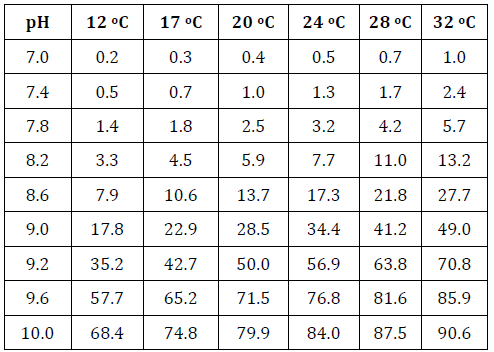
    A total of 5 ppm ammonia at pH 9 and a temperature of 20 ° C, the concentration of un-ionized ammonia is (5 ppm total ammonia) x 28.5% = 1.43 ppm.

    Table 3. Percent of total ammonia (ppm) are un-ionized at various temperatures and pH.
    image

    Effects of High Ammonia is:
    1. Occurrence of damage Gills
    2. The rate of growth eased
    3. Easy to disease
    4. Increase in blood ph
    5. Damage to the tissues and organs of internal parts
    6. Osmoregulation weak
    7. Death.

    Causes of High Ammonia:
    1. Feeding excess
    2. Decomposition of organic matter by bacteria.

    How to handle:
    1. Reduce the amount of feed
    2. Substitution of water
    3. Reduce the density of fish
    4. Provision of aeration
    5. Lowering the pH of the pool

  • Preservatives Fishery Products

    Preservatives such as ice and cold sea water, including material that is relatively safe to fish preserves, especially when consumed by the public. The use of preservatives that are not appropriate for the food ingredients, such as formalin, should be prevented and prohibited. Preservatives bodies were never scandalize the community, because it was used to preserve fish catches by fishermen.

    BBRP2B also conducting research on the use of fruit Picung as a preservative. Picung fruit for generations used to preserve the fish community in Banten, especially in Pandeglang and Lebak. Another way of preserving fish that is by freezing. To obtain a long shelf life of the fish must be frozen by using freezer and then stored frozen in cold storage.

    If that is done correctly allows to provide quality fish fresh fish approaching. The general consumer is usually difficult to distinguish between fresh fish and fish that have undergone freezing. Although many aspects to be considered in giving the definition of high quality fish, there are two main things that must be considered fishing as major manufacturers, namely: the quality of fish when caught, and the quality of fish when handed over to the buyer or processor.

    Especially for fast food products decompose, the quality of the fish is synonymous with freshness. Fresh terms included two meanings: the first one had just been arrested, not stored or preserved, and the second is still original quality, the quality has not deteriorated. Just out of high-grade raw materials will produce high-quality end product. Freshness quality is actually also has economic significance, because it is synonymous with money.

    This means that the quality of high freshness, the economic value will be high, and vice versa. The degree of freshness all types of tuna plays a role in assessing the quality and price of the end, in addition to the freshness is the most important factor in determining whether or not the quality healthy products consumed. Fresh fish when the fish is said to have the same body shape as the fish is still alive, where changes in physical, chemical and biological happened yet to cause serious damage to the fish flesh.

    Often it is difficult to distinguish the level of freshness of fish from one another. Based on the vision of both appear to have the same degree of freshness, but it turned out to just be known after it is saved. Fresh fish has a shelf life longer than the less fresh fish. The level of freshness of the fish can be determined based on the features it has. The level of freshness of the fish is very important because it can affect the appearance, aroma, flavor, texture and consumer preferences.

  • Between Product Definition

    Lately, people are starting to like fish in the form of products such as more practical and easily processed into a variety of finished products. The common understanding between the products is part of a fish that has undergone a specific treatment but still have properties such as fresh fish meat. Some of the intermediate products that have been developed and are favored by the public, among others:
    a. fillet
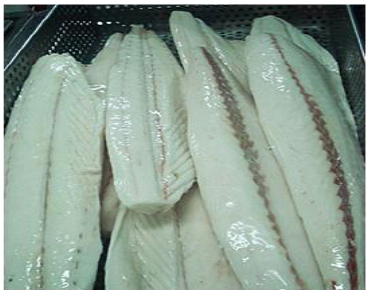
    Fillet is part fish meat obtained by slicing meat fish direction parallel to the spine without including parts of organs, heads, fins, bones and flesh colored. The hallmark is a clean white fish fillets or fish and flesh color corresponding cut in neatly. Therefore, the fillet must be made with a sharp knife and washed so that there are no blood stains that can affect the appearance.

    Based on the shape,) divides into two types, namely fillet crusted fillet (skin on) and skinless fillets (skin less). Fillet grouped into a single fillet (single fillet), the fillets are taken from one part of the fish and the double fillet (fillet blocks), the fillet is drawn from both sides of the fish’s body and then combined into one. Compared with whole fish, fillets are more susceptible to loss of quality. This is due to the fillet already do not have natural defenses.

    Therefore, to prevent loss of quality during the manufacturing process fillet progresses, the cleanliness of the environment must be considered and the application of the cold chain is absolutely necessary in order to obtain products with good quality fillet.
    image
    Figure 2. Fillet Gidara

    b. loin
    Loin is an intermediate product which is similar to the fillet, just how to make it different. Manufacture loin meat adapted to the structure of the fish. Loin generally made from raw materials that are large fish and fish torpedo-shaped body.
    image
    Figure 3. Fresh Whole fish products to processed products

    Stages Tuna Fish Handling Process in Place Transit Demolition
    Handling tuna after arrest or after harvest plays an important role in obtaining the maximum sale value of fish. One of the factors that determine the sale value of the tuna is the fitness level. The more fresh fish to the hands of the buyer or the consumer then the fish selling price will be higher. The freshness of the tuna fish can be seen from the appearance, smell, color of the meat, as well as texture. Basically, to get the fish that meet the required export destination good handling when the arrest operation, demolition (handling at the port), as well as the transportation process.

    Handling during the initial handling of the arrest operation. This is a limitation handling since fish caught to be landed at the port. Treatment of tuna during handling is not expected to cause physical damage, chemical composition and microbiological changes that can slow down the process of decay. Good fish handling is indispensable in order to maintain the quality and freshness of the fish were obtained.

    Handling time in port (unloading and transit) is an advanced handling after the fish arrived at the port. This is a limitation handling since the landed fish to be distributed, both for export and local requirements. Handling of fish during the demolition and removal to a place of transit is done carefully, clean, fast and cold. This is because fish is a product that is easily and quickly rot if not handled properly.

  • Barriers to Export Fishery Products

    The existence of barriers to export of tuna from the European Union to encourage the Department of Marine and Fisheries (DKP) implementing improved management and quality control. Results Improved quality management is done DKP showed a drastic reduction of cases of Rapid Alert System (RAS) is from 49 cases in 2005, dropping to 34 cases in 2006 and 17 cases in 2007. Indonesia is considered successful but still must be vigilant and disciplined in meeting predetermined quality standards, especially in the supervision of the entire tuna fish handling procedures, starting from the fishing, handling, landing (unloading and transit) as well as the distribution, which can enable an increase in histamine content (DKP 2008).

    Since 1970, cases of histamine poisoning has been a lot going on, for example, in Japan, the USA, Australia, New Zealand and the UK. Histamine is a biogenic amine formed by reaction of free histidine amino acid decarboxylation during post mortem phase due to bacterial activity. decarboxylation reaction caused by histamine-forming microorganism contamination, such as Morganella morganii, Klebsiella pneumoniae and Hafnia alvei.

    Contamination can occur from ship dismantling, processing sites, or at the time of the distribution chain to the consumer. Contamination and bacterial activity may be inhibited if the fish is handled correctly with attention to environmental sanitation and to always apply the principle of low temperature handling. Microbial contamination is likely to occur in poor sanitary conditions, for sanitation activities that do not prevent contact between food by insects or other contaminants and usually ends with a microbiological problem.

    Related to export marketing, aspects of product quality and food safety is an important factor that must be considered. Hazard Analysis Critical Control Point (HACCP) and Risk Analysis is a system in the application of the concept of security and hygiene of foodstuffs in an attempt to meet the requirements of the quality standards of food safety International trade. Systematic approach to risk analysis has been used by FAO and WHO since 1955, when evaluating the use of additives in food.

    With increasing time, continued development of the food safety system. In the early 1960s introduced practies Good Manufacturing (GMP), in 1971 introduced a formal system of Hazard Analysis Critical Control Point (HACCP) and in 1995 made the formal introduction of quantitative risk analysis. Risk analysis system has been recommended by the World Health Organization (WHO) to be applied in each country in an effort to control the quality and safety of food products, including fishery products.

    America and Europe have implemented this system of risk analysis, surveillance conducted by the US Food and Drug Administration (FDA) and Europe Food Safety Authority (EFSA). Indonesia as one of the countries exporting fishery products should also apply this risk analysis, because in addition to consumer protection food safety, it is also important in the international trading system. Risk analysis consists of three main components, namely risk assessment, risk management, and risk comunication.

    Risk assessment is composed of hazard characteristics, assessment of exposure / dose respone, hazard characterization and risk characterization. The results of the risk assessment is very important to know, because it will be used in the determination of risk management. Risk management is the development and implementation of strategy, implementation of management decisions, monitoring and review, which is expected to result in policy or decision that the company can control the risk of histamine. Tuna anticipate problems concerning enhancement histamine hazard risk is so great that the study “Assessment of the risk of histamine tuna (Thunnus sp.) Fresh quality range of export quality during the unloading process (transit)” needs to be done.

  • Tuna Fish Handling Process

    Stages tuna handling process is carried out as follows:
    1) Demolition tuna
    Ordinary tuna species landed are tuna yellow fin tuna (Thunnus albacares) and big eye tuna (Thunnus obessus). Tuna fish landed in the form of whole fish that have been weeded out the entrails and gills. Tuna fishing area includes Ocean waters of Indonesia, the northern coast of Java, and the waters south of Java up to Sulawesi. Tuna fishing vessel used was equipped with a cooling system refrigerated sea water (RSW).

    Time spent at sea usually is 25 days to 6 months. The number of fish that successfully landed every time the operation was 100-600 tail tuna. The quality of the tuna fish can be maintained when the treatment is applied on a boat made with care, clean, fast and cold. Tuna landed in the cold, with a maximum temperature of fish is -20C (measurements using thermo cople).

    2) Demolition
    Demolition of fish from the hold vessel performed after the ship docked to the demolition. Fresh tuna unloading process conducted in the morning around 09.00 am until 14.00 pm. Demolition tuna done in two ways, namely using a pulley and rope. The process of removal of the fish one by one from the hold of ships and transferred to the deck, then the fish sprayed with clean water.

    3) The transfer of tuna to transit
    Tuna has been dismantled moved to a transit point that has been provided. Fish removal process required special facilities, the plastic roof and boards launcher. This facility to protect the fish from being exposed to direct sunlight, because the distance of the ship at the jetty with a transit point far enough fish that have been removed from the hatch lifted to the deck, transported one by one to board the launcher. Withdrawals made by two people, one person in charge of attracting fish to board the launcher and another man pushing the fish into the transit room.

    4) Sorting (selection)
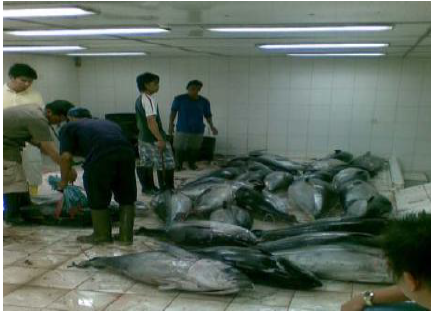
    Sorting fish intended for classifying fresh tuna that meet the quality requirements of export. Factors that may cause such a difference is the difference in time of death, manner of death, handling, sanitation, long at sea as well as the application of the cold chain. The sorting process conducted organoleptic (sightings, skin, eyes, texture and elasticity of meat and meat color). Organoleptic assessment texture, elasticity and color, carried out on samples taken from fish meat and a tail section behind the ventral fins, it is intended to prevent physical damage to the tuna will be exported.
    image
    Figure 7. Process Sorting by Checker